

Is Grass-Fed Tallow Safe for Toddlers: A Parent's Guide
Table of Contents
- What Is Grass-Fed Beef Tallow and How Is It Different?
- Is Grass-Fed Tallow Safe for Toddlers: The Core Safety Question
- Tallow Balm for Toddler Eczema and Dry Patches
- How to Apply Tallow Balm to Your Toddler's Skin
- Ingredient Purity and Processing: What to Verify
- When to Consult Your Pediatrician: A Checklist
- Tallow vs. Synthetic Moisturizers for Toddler Skin
- Frequently Asked Questions
Last Updated: September 18, 2026
What Is Grass-Fed Beef Tallow and How Is It Different?
Grass-fed beef tallow is a rendered animal fat made from cattle raised on pasture. It's composed primarily of triglycerides containing fatty acids that make it uniquely suited to nourishing skincare. Unlike conventional water-based lotions that rely on water as their main ingredient, tallow-based balms are anhydrous formulations centered on concentrated lipids and plant oils.
This difference matters when considering whether is grass fed tallow safe for toddlers. Water-based lotions require emulsifiers, preservatives, and stabilizers to keep water and oil phases combined. Tallow balms skip this entirely. They're built around grass-fed beef tallow, olive oil, jojoba oil, coconut oil, and vitamin E, no water phase, no emulsifiers needed.
When applied to skin, tallow provides rich lipids that soften and condition. It creates a protective layer that helps reduce moisture loss. Think of it as skin conditioning through concentrated fats and oils, not water delivery.
Field Flower Tallow Co. specializes in handcrafted anhydrous skincare. The brand's approach focuses on simple, recognizable ingredients that families can trust for sensitive skin. This matters when you're choosing what touches a toddler's delicate skin barrier.
Is Grass-Fed Tallow Safe for Toddlers: The Core Safety Question
Yes, grass-fed tallow is safe for toddlers when you follow proper precautions. Tallow itself is not toxic. It's a natural fat that has been used in skincare for generations. But "safe in general" and "safe for your specific toddler" are different questions.
Safety depends on three factors: the tallow's purity, the other ingredients in the formula, and your toddler's individual skin sensitivities. A high-quality tallow balm made with clean ingredients and proper handling poses minimal risk. But every child's skin is different.
Nutrient Profile and Fat-Soluble Vitamins
Grass-fed beef tallow contains vitamins A, D, E, and K, all fat-soluble nutrients that support skin health, which is why many parents ask is grass fed tallow safe for toddlers. These vitamins don't "add water" to skin. Instead, they work with the lipid base to nourish and condition.
Vitamin A supports skin cell turnover and barrier function. Vitamin D plays a role in skin immunity. Vitamin E acts as an antioxidant, protecting the skin from oxidative stress. Vitamin K supports skin healing.
For toddler skin, these nutrients matter because young skin is still developing its barrier function. A balm that delivers these fat-soluble vitamins can help support that natural development without harsh additives.
Field Flower Tallow Co.'s Sweet Dreams Baby Balm includes grass-fed tallow rich in these vitamins, plus olive oil, coconut oil, and vitamin E oil. This combination targets barrier support without unnecessary ingredients.

Potential Allergic Reactions and Sensitivities
Allergic reactions to tallow itself are rare. True beef tallow allergies are uncommon in toddlers. But reactions can happen to other ingredients in the formula, essential oils, plant oils, or botanical extracts.
Common sensitivities in toddler skincare include:
Sweet Dreams Tallow Baby Balm →
- Essential oils (lavender, chamomile, tea tree)
- Plant oils (coconut oil, jojoba oil)
- Botanical extracts (calendula, comfrey)
- Fragrance compounds (even natural ones)
If your toddler has eczema, atopic dermatitis, or a history of contact dermatitis, sensitivity risk goes up. Some children react to coconut oil. Others are fine with it but react to lavender oil.
The safest approach: start with an unscented formula. Field Flower Tallow Co.'s Unscented Tallow Face + Body Balm contains only grass-fed tallow, coconut oil, olive oil, and vitamin E oil, no essential oils or fragrance. This minimizes sensitivity triggers.
If your toddler tolerates the unscented version, you can later try formulas with gentle essential oils like those in the Sweet Dreams Baby Balm, which includes lavender and chamomile.
Tallow Balm for Toddler Eczema and Dry Patches
Eczema-prone skin needs barrier support and moisture retention. Tallow balms address both through lipid nourishment and protective barrier formation.
Eczema happens when the skin barrier is compromised. Water escapes, irritants enter, and inflammation follows.
A lipid-rich tallow balm works differently.
How to Apply Tallow Balm to Your Toddler's Skin
Patch Testing Protocol Before Full Application
Before using any new product on your toddler's face or body, patch test on a small area. This identifies sensitivities before they spread.
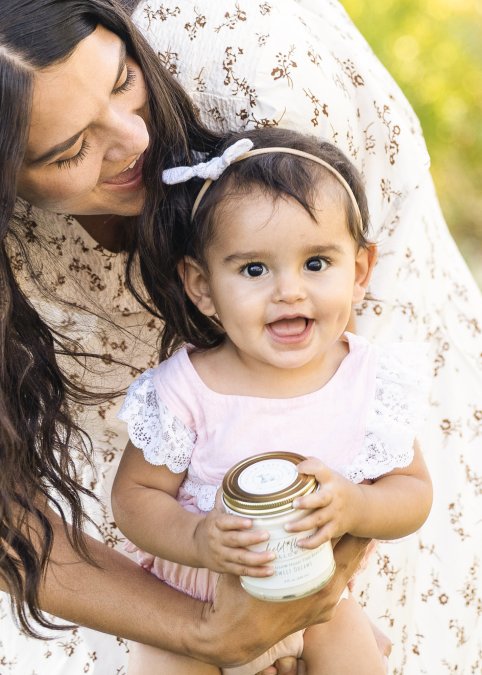
Patch testing steps:
- Choose a small, inconspicuous area (inner arm or behind the ear)
- Apply a tiny amount of balm (size of a grain of rice)
- Leave it on for 24 hours without washing
- Watch for redness, itching, swelling, or rash
- If no reaction appears after 24 hours, the product is likely safe
- If any reaction occurs, stop use and rinse the area
Daily Application Steps
Tallow balms work best when applied to clean, slightly damp skin. Here's the process:
- Bathe your toddler in warm (not hot) water
- Pat skin dry gently, leave it slightly damp, not dripping wet
- Scoop a small amount of balm (dime-sized for full body)
- Warm it between your hands for a few seconds until it softens
- Massage gently into skin using circular motions
- Focus on dry areas (elbows, knees, cheeks, hands)
- Let it absorb for a few minutes before dressing
Frequency depends on your toddler's skin:
- Dry or eczema-prone: twice daily (morning and evening)
- Mildly dry: once daily (usually evening)
- Normal skin with occasional dry patches: as needed
Ingredient Purity and Processing: What to Verify
When choosing a tallow balm for your toddler, verify three things: tallow sourcing, processing method, and ingredient transparency.
Check for:
Sweet Dreams Tallow Baby Balm →
- Complete ingredient list (no "proprietary blends")
- No synthetic preservatives (unless the formula contains water)
- No emulsifiers (unnecessary in anhydrous balms)
- No synthetic fragrances or dyes
- Clear sourcing information for oils and botanicals
When to Consult Your Pediatrician: A Checklist
Not every skin issue requires a doctor visit. But some situations demand professional guidance before starting tallow balm or any new skincare product.
Consult your pediatrician if your toddler has:
- Diagnosed eczema or atopic dermatitis (get clearance before switching products)
- Contact dermatitis or history of allergic reactions to skincare
- Active skin infection (bacterial, fungal, or viral)
- Severe or rapidly spreading rash
- Signs of systemic illness (fever, lethargy, swollen lymph nodes)
- Compromised immune system or chronic health conditions
- Currently prescribed topical medications for skin
Also consult if:
- Your toddler develops a reaction during patch testing
- Symptoms worsen after starting a new product
- Dry patches or rash don't improve after 2 weeks of consistent use
- Your toddler shows signs of infection (increasing warmth, pus, odor)
Tallow vs. Synthetic Moisturizers for Toddler Skin
Synthetic moisturizers include conventional lotions, creams, and many commercial baby products. They typically rely on water as the main ingredient, plus emulsifiers, preservatives, and humectants like glycerin.
Key differences:
Aspect |
Tallow Balm |
Synthetic Moisturizer |
|---|---|---|
Main ingredient |
Grass-fed tallow and plant oils |
Water |
Preservatives needed |
No (anhydrous formula) |
Yes (water requires preservation) |
Emulsifiers |
None |
Yes (to blend water and oil) |
How it works |
Lipid nourishment and barrier coating |
Water hydration plus emollience |
Absorption speed |
Slower, longer-lasting |
Faster, shorter-lasting |
Best for |
Dry, eczema-prone, sensitive skin |
Mild dryness, normal skin |
Tallow balms excel for toddlers with:
- Eczema or atopic dermatitis
- Chronic dry patches
- Sensitivity to conventional preservatives
- Parents who prefer recognizable, simple ingredients
Synthetic moisturizers work fine for toddlers with:
- Normal, non-sensitive skin
- Mild seasonal dryness
- Parents comfortable with conventional formulations
Frequently Asked Questions
Is grass-fed beef tallow actually safe for toddlers to use on their skin?
Grass-fed beef tallow can be safe for toddlers when sourced from reputable producers and applied carefully. Tallow is a rendered animal fat rich in fat-soluble vitamins A, D, E, and K that help nourish and condition delicate skin. However, every toddler's skin is different. Always patch test a small amount on a discreet area first and watch for 24–48 hours before applying to larger areas. If your toddler has diagnosed atopic dermatitis or severe skin sensitivities, consult your pediatrician before introducing any new skincare product, including tallow balms.
How do I know if tallow balm will cause an allergic reaction on my toddler's skin?
Allergic reactions to pure grass-fed tallow are rare, but they can occur. Signs include redness, swelling, itching, hives, or a rash appearing within 24–48 hours of application. Reactions are more likely if your toddler has a known beef allergy or extremely reactive skin. Start with a patch test on the inner arm or behind the ear—areas less visible and less likely to be rubbed. If any reaction appears, stop use immediately and rinse the area with plain water. Contact your pediatrician if symptoms persist or worsen.
Can tallow balm really help with eczema and dry patches on toddler skin?
Tallow balm can help support toddler skin with eczema or dry patches because it provides rich lipids that soften and condition the skin while helping reduce moisture loss. The fat-soluble vitamins in grass-fed tallow support the natural skin barrier. However, eczema is a complex condition and tallow alone may not resolve it. Use tallow balm for toddler eczema as a complementary approach alongside guidance from your pediatrician or dermatologist, especially for moderate to severe cases. Many parents find it helpful for maintaining skin softness between medical treatments.
What should I ask my pediatrician before using tallow balm on my toddler?
Ask your pediatrician: (1) Is tallow balm appropriate for my toddler's specific skin condition? (2) Are there any ingredients I should avoid? (3) Should I patch test first, and for how long? (4) If my toddler has a known beef allergy, is tallow safe? (5) Are there any medications or treatments that might interact with a lipid-based balm? (6) What signs of irritation should I watch for? Bringing a product ingredient list to the appointment helps your pediatrician give specific guidance.