

Non Greasy Grass Fed Tallow: How to Apply It Right
Table of Contents
- Why Some Grass Fed Tallow Feels Greasy (And Some Doesn't)
- How to Apply Tallow Balm So It Absorbs Quickly
- Benefits of Grass Fed Tallow for Your Skin Barrier
- What You'll Need Before You Start
- Common Mistakes That Make Tallow Feel Greasy
- Troubleshooting: When Your Skin Reacts or Stays Shiny
- Frequently Asked Questions
Last Updated: September 13, 2026
Why Some Grass Fed Tallow Feels Greasy (And Some Doesn't)
Non greasy grass fed tallow comes down to two things: how the fat was rendered and how you apply it. The same jar can feel like a heavy film on one person and melt in cleanly on another. At Field Flower Tallow Co., we hear this constantly from customers who tried tallow somewhere else and assumed all of it behaved the same way.
Grass fed tallow is rendered beef fat, composed mainly of triglycerides built from fatty acids. Its fatty acid profile, not its "oiliness," decides how quickly it sinks in.
How Fatty Acid Composition Affects Absorption
Tallow's texture comes from its balance of stearic and oleic acids. Stearic acid is a saturated fat that stays firm at room temperature, so it melts at skin temperature and spreads rather than sitting on top (pubchem.ncbi.nlm.nih.gov). Oleic acid is a monounsaturated fat that stays fluid and helps the balm glide (pubchem.ncbi.nlm.nih.gov).
A balm with more stearic acid feels firm in the jar and absorbs fast. One that leans too heavily on soft oils stays tacky. This is why the FDA's guidance on cosmetic ingredient labeling matters when you read a label: the order of ingredients tells you which fats dominate the formula.
The Role of Rendering and Filtration
Rendering is the process of melting raw fat to separate tallow from tissue and water. How thoroughly a producer filters afterward changes the final texture more than most people expect.
Poorly filtered tallow carries impurities that make a balm feel waxy and slow to absorb. Properly rendered, twice-filtered tallow is smoother and melts more evenly. If your balm feels greasy, check the source before you blame the fat itself.
How to Apply Tallow Balm So It Absorbs Quickly
The fastest way to apply tallow balm is to warm a pea-sized amount between your fingertips first, then press it into slightly damp skin. Cold balm straight from the jar is the single biggest reason people describe tallow as greasy.
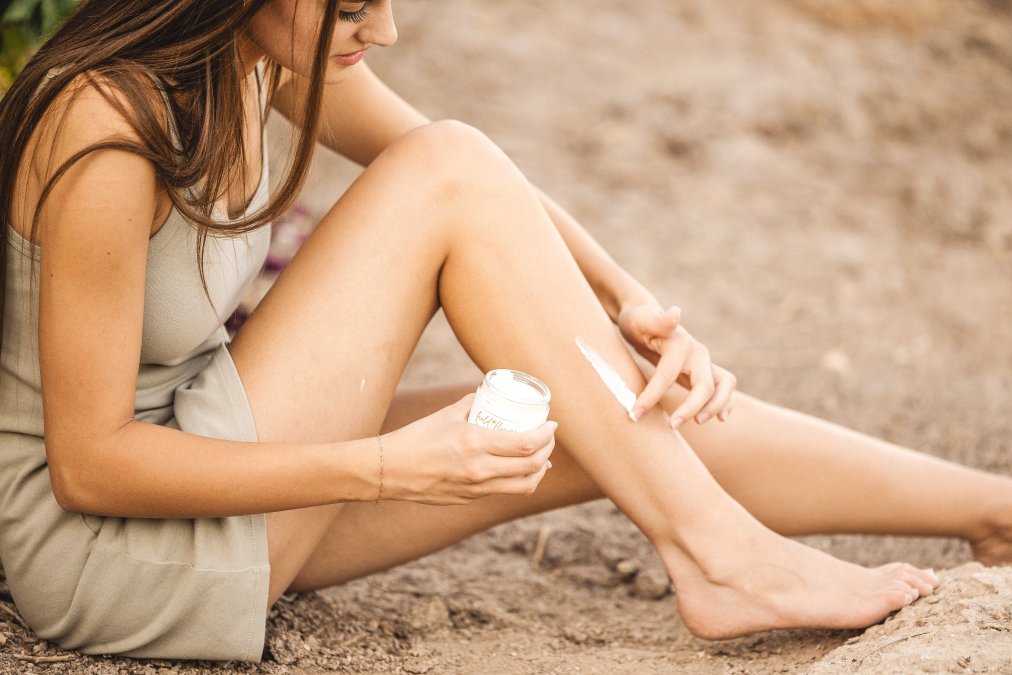
Close-up of a woman applying a small scoop of tallow balm on her legs, soft natural light, outdoors with a small jar of balm visible
Step-by-Step Application for Face and Body
- Wash your face or body and leave the skin slightly damp.
- Scoop a pea-sized amount with a clean fingertip or small spatula.
- Rub it between your palms for five to ten seconds until it turns glossy.
- Press, don't rub, into cheeks, forehead, and jawline.
- For the body, work in sections so the balm stays warm.
- Wait two minutes before applying makeup or dressing.
Expected result: skin that feels soft and conditioned, not slick.
How Much Balm to Use (And Why Less Is More)
Anhydrous balms are concentrated lipids, so a little covers a lot. Most people use three to four times more than they need on the first try, which is exactly why it feels heavy.
Start with a pea-sized amount for the face and a fingertip scoop per limb. Add more only if skin still feels tight after two minutes.
Benefits of Grass Fed Tallow for Your Skin Barrier
The benefits of grass fed tallow center on barrier support: the rich lipids in tallow help soften dry, rough skin and form a protective layer that reduces moisture loss. That layer is the whole point of an anhydrous balm.
Water and lipids do different jobs. Water contributes hydration; lipids condition the skin and help slow evaporation. A water-free balm doesn't need water to be an effective moisturizer.
Tallow also carries fat-soluble vitamins naturally, including vitamins A, D, E, and K, along with conjugated linoleic acid.
For very dry or reactive skin, apply to slightly damp skin so the balm can help seal in the water already there. It doesn't pull water in.
What You'll Need Before You Start
Getting the application right is easier with the right setup. You don't need much, but a few small tools make a real difference in how evenly the balm melts.
- A jar of anhydrous tallow balm, ideally unscented for first-time users
- A small spatula or clean fingertip
- A clean towel for patting skin slightly damp
- A mirror with good light for face application
- A cool, dark spot to store the jar
If you're starting with one product, start with our essential collection body balm which only has essential oils. Our Orange Jasmine Tallow Face + Body Balm is built exactly for that, and it works for both face and body.
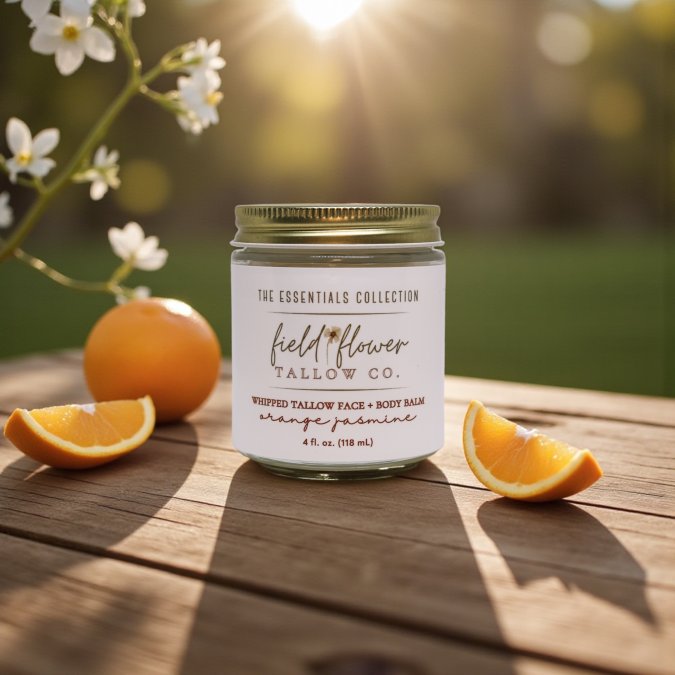
Orange Jasmine Tallow Face + Body Balm
Common Mistakes That Make Tallow Feel Greasy
Applying cold balm to dry skin is the number one mistake. Tallow needs warmth and a little surface moisture to spread evenly, and skipping either step leaves a film.
Other frequent errors:
- Using a scoop sized for lotion instead of a pea
- Rubbing instead of pressing, which pushes product around instead of in
- Layering balm over a water-based serum that hasn't dried
- Storing the jar somewhere warm so it separates
- Judging absorption in the first minute instead of the first hour
Troubleshooting: When Your Skin Reacts or Stays Shiny
A shiny finish usually means too much product, not a bad formula. Cut your amount in half and press rather than rub. If shine persists, apply at night only.
Redness, itching, or bumps are different. Stop using the product and patch-test on your inner arm for three days before trying again. Fragrance and essential oils are common triggers, so switch to an unscented formula if you were using a scented one.
If you have a diagnosed skin condition, talk to your dermatologist before adding any new product.
Problem |
Likely Cause |
Fix |
|---|---|---|
Greasy film |
Too much product |
Halve the amount, press in |
Tacky feel |
Applied to dry skin |
Apply to slightly damp skin |
Shine at midday |
Heavy daytime layer |
Switch to night application |
Redness or itching |
Fragrance sensitivity |
Move to unscented or essential oil only, patch-test |
Grainy texture |
Temperature swings |
Store cool and dark |
Frequently Asked Questions
Why does some tallow feel greasy on the skin?
Greasiness usually comes down to how the tallow was rendered and how much you apply. Tallow that still contains impurities or was extracted at very high heat can leave a heavier film. Using too much product is the most common cause. A small amount of well-rendered grass fed tallow warms quickly on skin contact and spreads thin, so it conditions without sitting on top of your skin.
How do you apply tallow balm so it absorbs quickly?
Start with clean, slightly damp skin. Warm a pea-sized amount between your palms until it melts, then press it into your face or body rather than rubbing. Pressing helps the lipids spread evenly and absorb into the skin barrier. For very dry areas, apply a second thin layer after the first has settled. A little goes a long way with anhydrous balms.
Does tallow balm leave a residue on the skin?
A properly formulated tallow balm should absorb within a few minutes, leaving skin soft rather than slick. If you notice residue, you likely used too much or applied it to skin that was already oily. Try halving your usual amount. Applying to slightly damp skin also helps the balm spread further and settle in faster, reducing any leftover film.
Can you use tallow balm on damp skin for better absorption?
Yes, applying tallow balm to slightly damp skin is one of the most effective ways to improve absorption. The water on your skin helps the balm spread more evenly and can reduce the amount of product you need. It also helps seal in the moisture already present on your skin's surface. Pat dry first if your skin is dripping wet, then apply.