

Best Tallow Balm for Eczema: 5 Picks That Soothe
Table of Contents
- Quick Comparison: Best Tallow Balms for Eczema
- How We Evaluated These Tallow Balms
- 1. Unscented Tallow Face + Body Balm: Best for Eczema-Prone Sensitive Skin
- 2. Sweet Dreams Tallow Baby Balm: Best for Children's Eczema
- 3. Lavender Mint Whipped Tallow Face + Body Balm: Best for Itchy, Irritated Patches
- 4. Soothing Slumber Magnesium Tallow Balm: Best for Nighttime Eczema Care
- 5. Vanilla Gardenia Magnesium Tallow Balm: Best for Full-Body Dryness
- Tallow Balm vs Conventional Eczema Lotion: What's the Difference?
- Frequently Asked Questions
Last Updated: September 14, 2026
Quick Comparison: Best Tallow Balms for Eczema
The best tallow balm for eczema is one formulated without added fragrance, because fragrance is among the most common triggers for reactive, eczema-prone skin. This guide from Field Flower Tallow Co. compares five fragrance-free and low-scent options, all built on grass-fed beef tallow and plant oils rather than a water phase.
Eczema care is tricky because reactive skin often reacts to the very ingredients meant to soothe it. According to the National Eczema Association's guidance on triggers and irritants, fragrances and certain preservatives rank among the most frequent culprits. That is why a short, recognizable ingredient list matters more than a long one.
Below, we break down five picks by use case, then explain how an anhydrous tallow balm differs from a conventional water-based eczema lotion.
Product |
Price |
Best For |
Scent |
|---|---|---|---|
$35.00 |
Eczema-prone sensitive skin |
None |
|
$60.00 |
Children's eczema |
Lavender, chamomile |
|
$45.00 |
Itchy, irritated patches |
Lavender, mint |
|
$45.00 |
Nighttime eczema care |
Lavender, eucalyptus, cedar |
|
$45.00 |
Full-body dryness |
Vanilla, gardenia |
How We Evaluated These Tallow Balms
We scored each balm on ingredient simplicity, scent load, lipid richness, and suitability for compromised skin. Fragrance-free formulas ranked highest for active flares, since added scent is a frequent irritant. We also weighed texture and spreadability, because a balm that drags on sore skin is one people stop using.
A Step-by-Step Patch Test for Eczema-Prone Skin
For reactive skin, the patch test is the safety step that matters most. Here is the protocol we recommend.
- Wait for a calm window. Test on clear, unbroken skin, never on an active, weeping, or scratched patch, which can worsen a flare and makes it impossible to tell what caused the reaction.
- Choose the site. The inner forearm or the side of the neck is standard. For a child, the inner upper arm works well.
- Apply a small amount. Roughly the size of a grain of rice, rubbed in gently. Use the same amount each time so results are comparable.
- Leave it alone for 24 to 48 hours. Do not wash the area aggressively or apply anything else on top. Note any redness, itching, stinging, or new bumps.
- Re-test before full use. If the first site stays calm, apply again to the same spot for two more days. Some reactions are delayed and only appear on repeat exposure.
- Introduce one product at a time. Testing a scented and an unscented balm in the same week means you will not know which one your skin tolerated.
Ingredient Interactions to Watch
Tallow itself is a relatively simple lipid. The variables that most often trigger reactions are the add-ons.
- Essential oils stacked together. A balm with lavender, peppermint, and eucalyptus is three potential irritants in one jar, not one. If you have reacted to scented products before, start with a single-note or unscented formula.
- Peppermint and raw or cracked skin. The cooling effect that feels good on intact itchy skin can sting sharply on skin that is already broken. Save mint-forward balms for calm stretches.
- Magnesium oil and open patches. Magnesium chloride oil is included in some balms for relaxation support, not as an eczema treatment. It can tingle or sting on compromised skin, so keep it to intact areas.
- Fragrance oils versus essential oils. These are not the same category. A "natural" label does not guarantee a fragrance oil is gentler than an essential oil, and both can irritate reactive skin.
- Botanical extracts and honey. Raw honey or botanical infusions are generally well tolerated but are still additional variables. The fewer unfamiliar ingredients during a flare, the easier it is to isolate a trigger.
The practical takeaway: during a flare, the shortest ingredient list wins. Once skin is calm, introduce one scented or active balm at a time, giving each a full week before adding another.
Storage and Shelf Life for Water-Free Balms
Because these balms are anhydrous, they do not carry the same microbial risk profile as a water-based lotion, but they are not immune to contamination. Water from wet fingers, a damp bathroom, or a dirty lid can still create problems.
- Keep water out. Scoop with clean, dry hands or a small spatula. Never introduce a wet finger into the jar.
- Store away from heat and direct sun. High temperatures can cause the oils to oxidize faster and change the balm's texture. A cool, dark cabinet is ideal.
- Watch for changes. A shift in smell, color, or texture, especially a rancid or crayon-like odor, is a sign the oils have oxidized. Vitamin E helps slow this, but does not stop it indefinitely.
- Mind the jar size. A 9 oz jar lasts longer but is exposed to air and fingers more often. If you use balm daily, a smaller jar replaced more frequently can stay fresher than a large one you dip into for months.
- Check the label for a use-by window. Most small-batch anhydrous balms are best used within 12 months of opening, though this varies by formula and storage.
1. Unscented Tallow Face + Body Balm: Best for Eczema-Prone Sensitive Skin
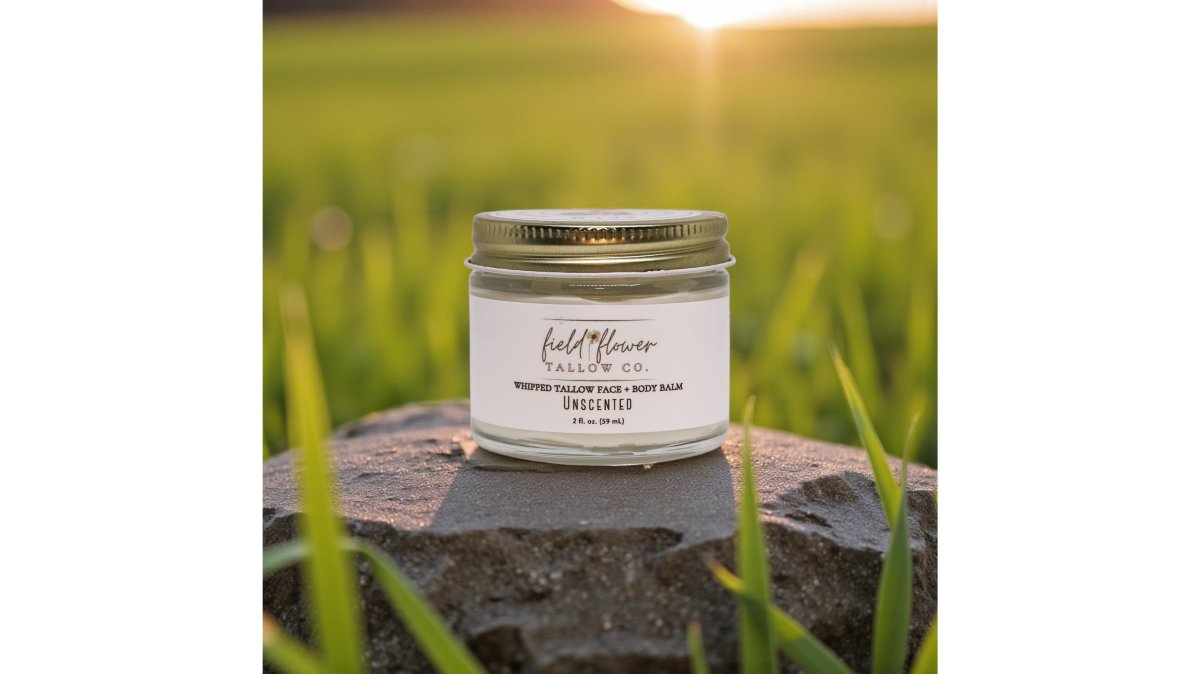
Our top pick for eczema-prone skin is the Unscented Tallow Face + Body Balm, because it contains no added fragrance or essential oils. For reactive skin, that single detail matters more than any marketing claim.
Unscented Whipped Tallow Face + Body Balm
The formula centers on grass-fed beef tallow plus organic coconut oil, organic extra virgin olive oil, and vitamin E. That is the entire list. No fragrance, no essential oils, nothing added to make it smell like anything other than tallow and oil.
Because it is anhydrous, this balm delivers concentrated lipids that condition the skin and form a protective layer that helps reduce moisture loss. It is not a water-based lotion.
Best for: sensitive or reactive skin, babies and children, and anyone who wants a completely neutral balm.
One limitation: because there is no scent at all, it smells faintly of tallow. If you want a scented ritual, this is not the one.
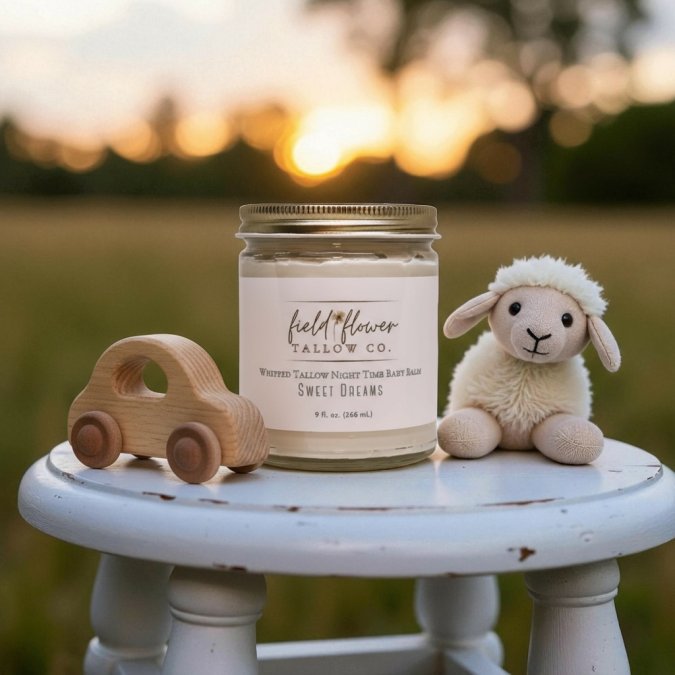
2. Sweet Dreams Tallow Baby Balm: Best for Children's Eczema
For children's eczema, the Sweet Dreams Tallow Baby Balm pairs grass-fed tallow with lavender and chamomile essential oils, the gentlest scented option in the lineup, designed for delicate skin.

A parent's most common worry is a reaction to essential oils, and that concern is fair. If your child has reacted to scented natural products before, start with the Unscented balm and introduce scent only once skin is calm.
Best for: dry or sensitive baby skin, diaper-area dryness, and a calming bedtime routine. The lavender and chamomile scent doubles as part of the wind-down ritual.
One limitation: it is the highest-priced balm here at $60.00, and it contains essential oils, so it is not the choice for a child mid-flare.
3. Lavender Mint Whipped Tallow Face + Body Balm: Best for Itchy, Irritated Patches
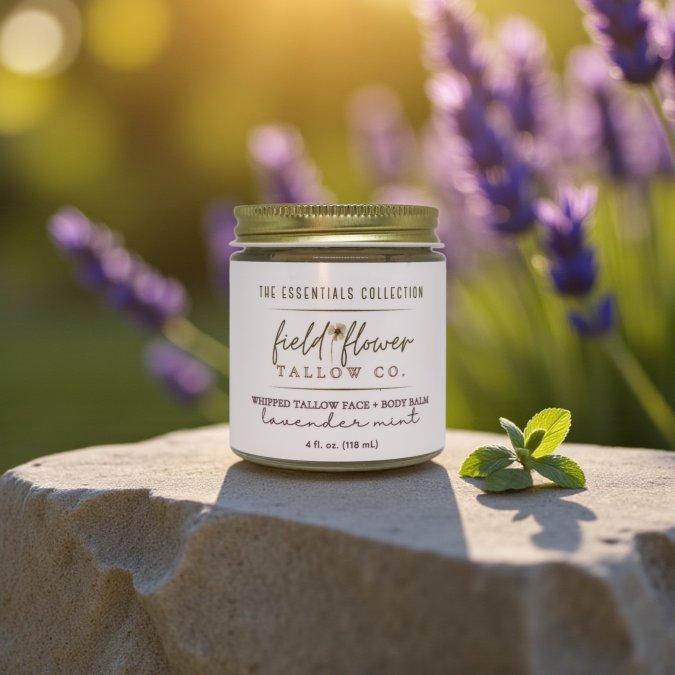
Itch drives most scratching, and scratching drives most flares. The Lavender Mint Whipped Tallow Face + Body Balm adds a cooling peppermint note that many people find soothing on itchy, irritated patches.
The base is the same lipid-rich tallow, olive, coconut, and jojoba blend, with carrot seed oil and vitamin E. Lavender calms; peppermint cools. If your skin is raw rather than merely itchy, the mint can sting, so patch test first.
Lavender Mint Whipped Tallow Face and Body Balm
Best for: itchy, irritated patches and evening relaxation routines. The 4 oz jar is $45.00.
One limitation: both lavender and peppermint are essential oils, so this is not a fragrance-free pick.
4. Soothing Slumber Magnesium Tallow Balm: Best for Nighttime Eczema Care
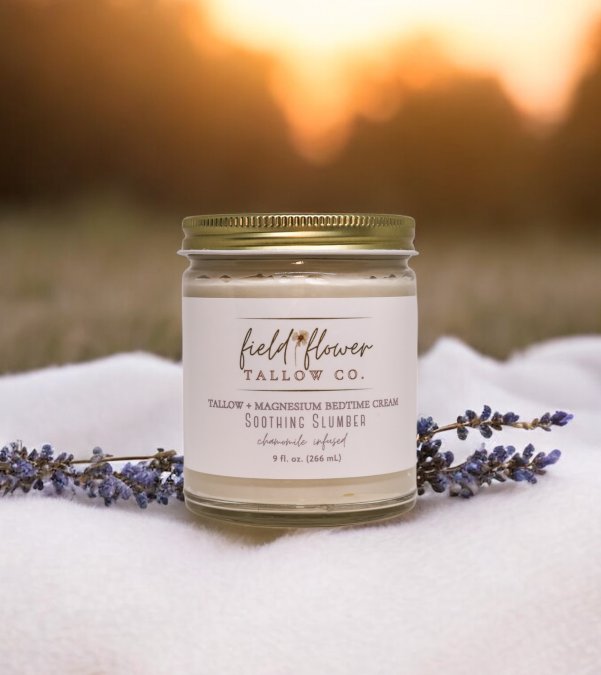
Nighttime is when eczema itches worst for many people, and this balm is built for exactly that. The Soothing Slumber Magnesium Tallow Balm combines tallow, chamomile-infused olive oil, magnesium oil, and a lavender, eucalyptus, and cedar blend.
Magnesium oil is included to help support relaxation, not as an eczema treatment. This is a body balm for winding down, and the rich lipids help condition dry skin overnight.
Soothing Slumber Tallow and Magnesium Bedtime Cream
Best for: nighttime routines, tired muscles, and dry skin on legs, arms, and shoulders.
One limitation: it contains fragrance oils and should not be applied to broken or irritated skin. For an active flare, choose the Unscented balm.
5. Vanilla Gardenia Magnesium Tallow Balm: Best for Full-Body Dryness
If your eczema sits alongside widespread dryness rather than isolated patches, this full-body balm covers more ground per application. The Vanilla Gardenia Magnesium Tallow Balm layers warm vanilla and soft gardenia over the same tallow and magnesium base.
The scent is the draw here, and it is worth being honest: a scented balm is a maintenance choice, not a flare choice. Once skin is calm, a scent you enjoy makes daily application something you look forward to, and that consistency keeps dry skin from tipping back into a flare.

Vanilla Gardenia Tallow and Magnesium Whipped Balm
Best for: full-body dryness and evening self-care.
One limitation: fragrance blend means it is not suitable for highly reactive skin or children.
Tallow Balm vs Conventional Eczema Lotion: What's the Difference?
The core difference is the formulation itself, not just the ingredient list. A conventional eczema lotion is an emulsion built around a substantial water phase. That water makes the lotion spreadable and lightweight, but it is also why the formula needs emulsifiers to hold the oil and water together and preservatives to keep microbial growth in check. A tallow balm is anhydrous: it contains no water phase at all, so it is built differently from the ground up.
A water-based lotion delivers hydration through its water content, then relies on oils and other ingredients to help slow moisture loss. A tallow balm skips the water entirely and delivers concentrated lipids that condition the skin and form a protective layer to help reduce moisture loss. Water and lipids perform different roles: water contributes hydration, while lipids help condition the skin and reduce moisture loss. A water-free balm does not need to contain water to be an effective moisturizer.
Why Tallow's Lipid Profile Matters
Tallow is a rendered animal fat composed primarily of triglycerides containing fatty acids. That lipid composition is what makes it well suited to rich, nourishing skincare. When applied, tallow provides a source of lipids that can help soften and condition the skin, and its rich texture creates a protective layer on the skin's surface that can help slow moisture loss.
It is worth being precise here, because a lot of marketing language overshoots. Tallow and human sebum share similarities in their lipid components, but they are not identical, and tallow does not "replace" the skin's natural oils. What tallow offers is a concentrated source of lipids that conditions the skin and supports the barrier, not a chemical match for what your skin produces on its own.
Practical Trade-Offs
Neither approach is better in the abstract. They suit different skin, routines, and moments in an eczema cycle.
- Texture and feel. Water-based lotions are lighter and absorb quickly, which many people prefer for daytime or large areas. Tallow balms are richer and more concentrated, so a small amount goes a long way.
- Duration. For very dry, compromised skin, many people find the lipid-rich approach more lasting through the day and overnight.
- Ingredient load. A water-based lotion needs emulsifiers and preservatives to remain stable. An anhydrous balm has no water phase, so it does not require those same systems, but it still needs careful handling to keep water out of the jar.
- Sensation on broken skin. Rich balms can feel heavy on an active flare. Some people prefer to use them on intact, dry skin and switch to a lighter product during acute flares.
- Layering. A common pattern is to apply a balm to slightly damp skin after a bath. The balm helps seal in the water already on the skin's surface and slow its evaporation. It does not pull that water in; it simply helps hold it there.
What the Evidence Does and Does Not Show
Eczema is a chronic, relapsing condition, and no single topical product resolves it. There is no large body of clinical trials specifically on tallow balm for eczema, so claims that it "cures" or "heals" eczema are not supported. What the evidence does support is the general principle that consistent, gentle moisturizing helps manage dryness and supports the skin barrier, which is why the American Academy of Dermatology's guidance on bathing and moisturizing emphasizes regular moisturizing as part of an eczema routine.
If you are managing moderate to severe eczema, a tallow balm is a complement to, not a replacement for, the treatment plan your dermatologist recommends. For mild dryness and barrier support between flares, a simple, fragrance-free anhydrous balm is a reasonable option to try, patch tested first.
For anyone managing chronic dryness day to day, this is where the American Academy of Dermatology's guidance on bathing and moisturizing is useful: consistent, gentle moisturizing matters more than any single product.
Frequently Asked Questions
Is tallow balm good for eczema?
Tallow balm is a lipid-rich, water-free moisturizer that helps soften dry, rough skin and supports the skin barrier by forming a protective layer that reduces moisture loss. It contains fatty acids and vitamins A, D, E, and K. While no balm cures eczema, many people with eczema-prone skin find tallow balm soothing because it conditions without water, emulsifiers, or synthetic preservatives that can sometimes irritate sensitive skin.
How does anhydrous tallow balm differ from water-based eczema creams?
Conventional eczema creams are emulsions with a substantial water phase, so they need emulsifiers and preservatives to stay stable and microbe-free. Anhydrous tallow balm contains no water phase at all. Instead, it delivers concentrated lipids from grass-fed tallow and plant oils that coat and condition the skin, helping reduce moisture loss. The two work differently: water-based creams add hydration, while lipid-based balms seal in moisture and support the barrier.
What ingredients should you look for in a tallow balm for sensitive skin?
Look for grass-fed beef tallow as the primary lipid, plus simple plant oils like olive, jojoba, or coconut oil. Vitamin E helps protect the oils from oxidation. For very sensitive or reactive skin, choose a fragrance-free option with no essential oils, such as an unscented tallow balm. Avoid balms with long ingredient lists or added synthetic preservatives if your skin reacts easily.
Can tallow balm help reduce moisture loss in dry, irritated skin?
Yes. Tallow and the plant oils in a balm create a protective, lipid-rich layer on the skin's surface that helps slow transepidermal water loss. For best results, apply to slightly damp skin after a bath or shower. The balm helps seal in the water already on your skin, then continues conditioning as it absorbs. A small amount goes a long way because the formula is concentrated.
Is tallow balm safe for daily use on eczema patches?
Most people can use tallow balm daily on dry, eczema-prone areas. Start with a patch test on your inner forearm and wait 24 hours before applying to larger areas. If you have broken, weeping, or infected skin, talk to your doctor first. For children or babies, choose a gentle formula and patch test as well. Discontinue use if you notice redness, itching, or swelling.