

How to Identify High-Quality Grass-Fed Tallow
Table of Contents
- Start With the Source: Suet, Fat Trim, and What "Grass-Fed" Really Means
- Reading a Grass-Fed Beef Tallow Label: Claims, Certifications, and Red Flags
- What Grass-Fed Tallow Color Can and Cannot Tell You
- How to Tell if Tallow Is Rancid: Smell, Texture, and Storage Checks
- Rendering Quality: Dry-Rendered Fat and Measurable Indicators
- Tallow Balm Ingredients: What a Clean, Water-Free Formula Looks Like
- Food-Grade vs. Cosmetic-Grade Tallow: Which One Belongs on Your Skin?
- Questions to Ask a Seller Before You Buy
- Frequently Asked Questions
Last Updated: October 20, 2026
Start With the Source: Suet, Fat Trim, and What "Grass-Fed" Really Means
Learning how to identify high quality grass fed tallow starts with one fact: the fat you buy is only as good as the animal it came from. At Field Flower Tallow Co., we work with grass-fed, grass-finished beef tallow because the source decides almost everything about the finished product.
So before you judge color or texture, ask where the fat came from and how the animal was raised.
Suet vs. General Beef Fat
General beef fat and fat trim come from other parts of the animal. They often carry more muscle and membrane, so they need more careful trimming and rendering. Both can produce usable tallow.
When you shop, look for the word "suet" or "kidney fat" on the label. A seller who names the fat source is usually a seller who knows their supply chain.
Grass-Fed vs. Grass-Finished
These two terms are not the same, and the difference matters.
- Grass-fed usually means the animal ate grass for most of its life. It does not guarantee grass was the only feed.
- Grass-finished means the animal stayed on grass through the finishing period, right up to harvest.
A label that says "grass-fed, grass-finished" makes a stronger claim than "grass-fed" alone. Neither term is tightly policed on its own, so treat the wording as a starting point and look for proof behind it.
Reading a Grass-Fed Beef Tallow Label: Claims, Certifications, and Red Flags
A grass-fed beef tallow label tells you what the seller wants you to believe. Certifications tell you what someone else verified. Learn to separate the two, and learn what each type of proof can actually substantiate.
Start with the ingredient list. High-quality tallow should read as a single ingredient: rendered beef tallow. Some sellers add rosemary extract or vitamin E to slow oxidation, and that is reasonable.
What a Certification Actually Verifies
A certification is only as strong as its standard and its audit process. When you see a logo, ask three questions: Who wrote the standard? Who audits the farm or facility?
- USDA Organic is the one claim with a federal legal definition and an enforcement structure. It is administered by the USDA Agricultural Marketing Service National Organic Program, and certified operations are inspected at least annually by an accredited certifying agent. Organic does not equal grass-finished, but it does tell you something verifiable about feed and pasture management.
- Animal Welfare Approved (administered by A Greener World) requires audited, pasture-based management with high welfare standards, and its standards are publicly posted. It is one of the few programs that ties a grass-based claim to an on-farm audit.
- Certified Grassfed (also A Greener World) requires a written grazing plan, audits, and a documented diet of grass and forage. It is a stronger claim than an unverified "grass-fed" label because the standard is published and the farm is inspected.
A certification logo with a traceable program name and a published standard beats a vague "natural" badge every time. "Natural" has no independent verification behind it for this kind of claim.
How to Verify a Claim Yourself
You do not have to take a logo at face value. A few minutes of checking will tell you a lot:
- Look up the certifier. Every legitimate program publishes its standards and a list of certified operations. If you cannot find the seller on that list, the logo is decoration.
- Ask for the farm name. A seller who names the ranch or cooperative is usually a seller who knows the supply chain. "Blended from domestic and imported sources" is the opposite of traceability.
- Ask for a batch or lot number. Batch coding is what lets a maker trace a specific jar back to a specific render and a specific fat source. No batch information means no traceability.
- Ask what the audit covers. A feed audit is not the same as a welfare audit, and neither is the same as a pasture audit. The answer tells you how deep the verification goes.
Red Flags to Watch For
- "Grass-fed" with no supporting certification, farm name, or program
- The word "pure" used with no explanation
- No lot or batch information
The USDA Agricultural Marketing Service publishes labeling standards for meat and poultry claims, and it is a useful starting point for understanding which terms have legal definitions and which do not.
What Grass-Fed Tallow Color Can and Cannot Tell You
Grass-fed tallow color ranges from pale cream to a deep golden yellow.
Color comes from several places: the animal's diet, its breed, the season, and how the fat was rendered.
Here is what color can tell you: an even, consistent tone across a jar suggests careful rendering and clean fat.
Use color as one clue among several, never as the whole verdict.
How to Tell if Tallow Is Rancid: Smell, Texture, and Storage Checks
Fresh tallow should smell mild and neutral, with a faint beef note at most. Rancid fat smells sharp, sour, or like old cooking oil.
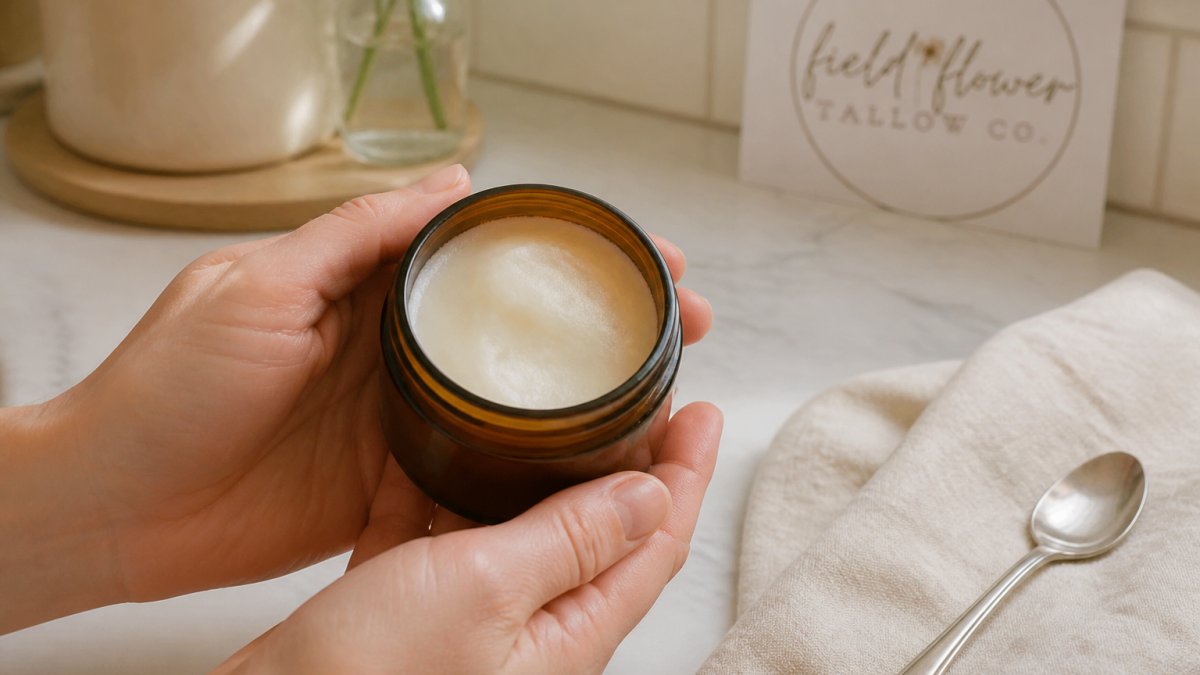
Texture matters too. Good rendered tallow is smooth and non-gritty. If it feels grainy or waxy, the render may have been uneven or the fat poorly trimmed.
Storage protects all of this. Keep tallow cool, dry, and away from direct light. An amber jar or opaque jar slows oxidation.
Rendering Quality: Dry-Rendered Fat and Measurable Indicators
Dry-rendered fat is cooked without added water, so the finished tallow stays concentrated and clean-tasting. Wet rendering uses water to separate fat, which can leave more moisture behind and shorten shelf stability.
You can spot a careful render without a lab:
- Even color with no dark or burned patches
- Smooth, non-gritty texture when cooled
- Neutral smell with no sour or sharp notes
Poorly rendered fat often shows the opposite: a scorched smell, visible sediment, or a greasy film that never quite firms up. These are the measurable quality indicators you can check at home.
Tallow Balm Ingredients: What a Clean, Water-Free Formula Looks Like
A tallow balm is not a lotion with the water taken out. It is a different kind of product entirely.
Conventional lotions are emulsions built around a water phase, which is why they need emulsifiers and preservatives to stay stable. An anhydrous balm has no water phase at all.
When you read a tallow balm ingredients list, expect:
- Rendered beef tallow listed first
- Simple plant oils
- Optional beeswax for structure
- Vitamin E or rosemary extract as an antioxidant
If a "tallow balm" lists water near the top, it is a lotion, not an anhydrous balm.
Food-Grade vs. Cosmetic-Grade Tallow: Which One Belongs on Your Skin?
"Food-grade" and "cosmetic-grade" are not interchangeable, and neither term is a single, federally defined quality tier. Understanding what each one actually means in practice will help you ask better questions and read a seller's answer more sharply.
What the Terms Mean in Practice
Food-grade tallow is rendered to standards set for human consumption. The relevant framework is the FDA Food Safety Modernization Act, which sets preventive-controls requirements for food facilities, and the USDA Food Safety and Inspection Service, which oversees meat and poultry products.
Cosmetic-grade tallow is rendered for use in skincare. The relevant framework is the FDA regulation of cosmetics, which governs labeling and safety but does not pre-approve cosmetic ingredients or set a separate "grade" for tallow.
Why the Distinction Matters for Skincare
For skincare, the question is not "could I eat it?" but "was this fat handled with skin contact in mind?" A food-grade tallow can be perfectly clean and still be a poor choice for a balm if it was rendered for cooking, stored in a way that picked up odors, or handled without cosmetic use in mind.
Food-grade tallow is not automatically better for your skin just because you could eat it. The two grades answer different questions.
Questions That Separate a Careful Maker from a Marketer
Ask the seller directly:
- Which grade do you use, and why did you choose it over the other?
- How is the fat cleaned and filtered, and to what specification?
- Is there a batch record or certificate of analysis for the render?
- How is the finished tallow stored before it goes into a balm?
A clear, specific answer signals a maker who has thought about the difference. A vague answer, or a claim that one grade is simply "better", is your cue to keep looking.
The FDA guidance on cosmetic labeling is a useful reference for understanding what a label must legally disclose. It will not rate quality for you, but it helps you read claims with sharper eyes.
Questions to Ask a Seller Before You Buy
The fastest way to separate a careful maker from a marketer is to ask direct questions. Here is the checklist we would want a buyer to use on us.
- Where does your tallow come from, and is it grass-fed and grass-finished?
- Do you use suet or general fat trim?
- Is your tallow dry-rendered?
- Is it food-grade or cosmetic-grade, and why did you choose that?
The FDA guidance on cosmetic labeling is a useful reference for understanding what a label must legally disclose. It will not rate quality for you, but it helps you read claims with sharper eyes.
Frequently Asked Questions
How can you tell whether tallow is truly grass-fed?
Start with documentation, not appearance. Look for a named certification on the label, such as USDA Organic or a verified grass-fed program, and ask the seller which farm supplied the fat. A reputable producer can describe the animal's diet and the supply chain in plain terms. Be cautious of labels that say "grass-fed" with no certifying body, no farm name, and no contact information. Color alone will not confirm diet, because breed, age, and rendering method all shift the shade of finished grass-fed tallow.
Does the color of beef tallow indicate its quality?
Grass-fed tallow color ranges from pale ivory to deep yellow, and that variation comes from the animal's diet and breed as much as from quality. A golden hue often reflects carotenoids from pasture, but a pale batch can still be fresh and well rendered. What matters more is evenness: a jar with one uniform color throughout is a better sign than streaks, dark spots, or a grayish tinge. Treat color as one clue among several, alongside smell, texture, and sourcing paperwork.
How can you tell if beef tallow is fresh or rancid?
Smell is the fastest test. Fresh rendered tallow has a neutral, mild odor, while rancid fat smells sharp, sour, or like old cooking oil. Texture helps too: fresh tallow is smooth and non-gritty, while oxidized fat can feel tacky or develop a grainy surface. Check the jar for a production or best-by date and store tallow in a cool, dark place. If a product smells off when you open it, contact the seller rather than applying it to your skin.
What should you look for in tallow balm ingredients?
A simple, readable list is the goal. Field Flower Tallow Co. balms are water-free and built around grass-fed beef tallow plus plant oils such as olive, jojoba, and coconut, with beeswax in some formulas and vitamin E to help protect the oils from oxidation. Read the full ingredient list and confirm each item is one you recognize. If a label hides behind a proprietary blend or lists ingredients you cannot identify, ask the seller for details before buying.
Buying quality tallow takes a little homework, and most of it happens before you open the jar. If you would rather skip the guesswork, Field Flower Tallow Co. makes anhydrous, tallow-based skincare from grass-fed, grass-finished beef tallow, with clean ingredients you can actually read and scents that do not smell like a butcher counter. Explore our balms and bundles, try a single product first, and see how a concentrated, water-free formula feels on your skin.