

Can Pregnant Women Use Tallow Based Skincare?
Quick Summary
Tallow based skincare is generally a personal choice to discuss with your care provider, because no tallow product has been specifically studied as a pregnancy treatment. Choose a fragrance-free formula with a short ingredient list, avoid topical retinoids, and patch test before regular use. A tallow balm can soften stretching skin but cannot prevent or remove stretch marks.
- Tallow balms are water-free, so they condition and soften skin rather than hydrate it.
- No tallow product has been specifically studied as a pregnancy skincare treatment.
- Choose a fragrance-free formula and read the full ingredient list before buying.
- Most clinicians advise avoiding topical retinoids during pregnancy as a precaution.
- Patch test on the inner forearm for 24 to 48 hours before using on larger areas.
Table of Contents
- How Tallow Based Skincare Differs From a Lotion
- Is Tallow Based Skincare Safe During Pregnancy?
- Tallow for Stretch Marks: What It Can and Cannot Do
- Pregnancy-Safe Skincare Ingredients to Look For
- Skincare Ingredients to Avoid During Pregnancy
- Essential Oils in Skincare During Pregnancy
- How to Patch Test and Start a Tallow Balm Routine
- Choosing a Fragrance-Free Tallow Balm for Your Pregnancy Routine
- Frequently Asked Questions
How Tallow Based Skincare Differs From a Lotion
Tallow based skincare is an anhydrous product, meaning it contains no water. That single fact changes how it works.
Most lotions are emulsions with a large water phase. They combine water, humectants, oils, emulsifiers, preservatives, and stabilizers so the water and oil stay blended. A tallow balm has none of that structure. Instead, it is built from concentrated fats and oils such as grass-fed beef tallow, olive oil, jojoba oil, and coconut oil.
Because there is no water, the balm does not hydrate the skin the way a lotion does. It softens and conditions the skin, forms a protective lipid layer, and helps reduce moisture loss.
Is Tallow Based Skincare Safe During Pregnancy?
Tallow is a rendered animal fat made mostly of triglycerides. Some people choose a simple, fragrance-free tallow balm because it has a short, recognizable ingredient list. Readers wondering about tallow safety for babies can find a dedicated guide on whether tallow is suitable for babies. Still, no tallow product has been specifically studied as a pregnancy skincare treatment, so the honest answer is that it is a personal choice to make with your care provider.
A practical approach looks like this:
- Check the full ingredient list before buying
- Choose a fragrance-free formula to limit irritation
- Ask your OB-GYN or midwife if you have questions about any topical product
- Stop using any product that causes redness, burning, or itching
Tallow for Stretch Marks: What It Can and Cannot Do
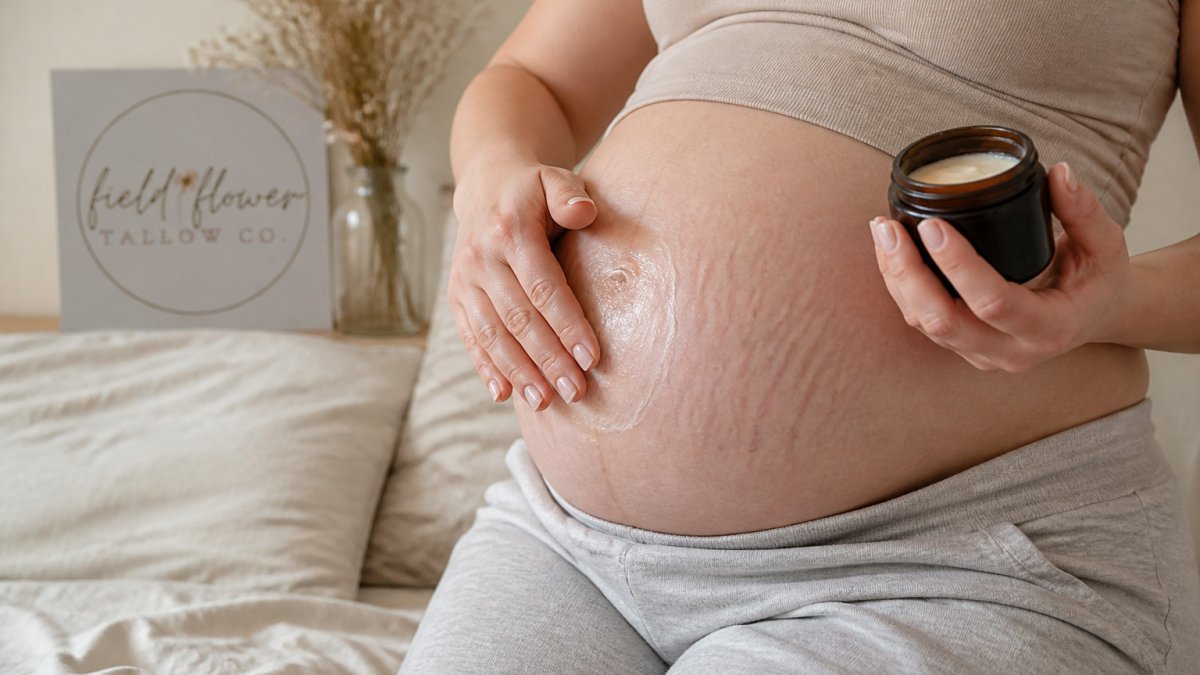
Stretch marks (striae) are a common concern during pregnancy, and rich balms are often applied to the belly, breasts, hips, and thighs as the skin stretches. It helps to separate what a tallow balm can realistically do from what it cannot.
What stretch marks actually are. Striae form when the skin stretches faster than its supporting structures can adapt. The dermis contains collagen and elastin fibers that give skin its resilience; when rapid stretching outpaces that resilience, those fibers can tear, and the resulting marks move through stages. Early striae often appear pink, red, or purple (striae rubrae) and may feel slightly raised. Over months to years they typically fade to a silvery or white tone (striae albae) and may feel slightly depressed. Genetics, hormones, rate of weight gain, and skin type all influence who develops them and how many.
What a tallow balm can do. A lipid-rich, water-free balm softens and conditions the skin, helps reduce moisture loss, and creates a protective layer on the surface. For skin that feels tight or uncomfortable as it stretches, that conditioning may make the area feel more comfortable. It supports the skin's surface rather than restructuring the dermis.
What a tallow balm cannot do. No topical balm, tallow-based or otherwise, has been shown to prevent stretch marks or remove existing ones. Moisturizing does not change the genetic, hormonal, and mechanical factors that drive striae formation. Treat any claim that a balm will prevent stretch marks, erase them, or 'rebuild collagen' with skepticism, including claims made about tallow. The evidence for topical products in this area is limited and mixed at best.
Unscented Tallow Face + Body Balm →
Realistic expectations, in practice.
- Use a balm for comfort: softening tight, itchy, stretching skin is a legitimate reason to apply it.
- Apply to slightly damp skin after a shower to help seal in moisture already on the surface.
- Be consistent but not excessive; a thin layer once or twice a day is enough, and a small amount goes a long way with a concentrated balm.
- Expect fading over time regardless of what you apply; the natural course of striae is to soften and lighten.
- If itching is intense, widespread, or accompanied by a rash, talk to your care provider, because persistent itching in pregnancy can have causes that skincare will not address.
Pregnancy-Safe Skincare Ingredients to Look For
When you shop for a pregnancy-safe option, look for short ingredient lists with items you recognize. Strong candidates include:
- Grass-fed beef tallow
- Olive oil or jojoba oil
- Coconut oil
- Beeswax
- Vitamin E (tocopherol)
Choose products without added fragrance when possible. The Unscented Tallow Face + Body Balm, for example, lists only a few ingredients and contains no added fragrance or essential oils.
Skincare Ingredients to Avoid During Pregnancy
Most pregnancy skincare guidance focuses on a short list of ingredients that are commonly discussed as ones to limit. It is worth understanding why they are flagged and how that reasoning applies (or does not apply) to a simple, water-free tallow balm.
Ingredients commonly flagged during pregnancy.
- Retinoids (retinol, retinyl palmitate, tretinoin, adapalene, tazarotene). These are the most consistently flagged topical ingredients in pregnancy. The concern comes from their role in vitamin A signaling and from oral isotretinoin's known risks; topical absorption is far lower, but most clinicians still advise avoiding topical retinoids during pregnancy as a precaution. If you are unsure whether a product contains one, check the label.
- High-strength salicylic acid. Low-strength salicylic acid in a cleanser or toner is generally considered low-risk by many clinicians, but high-concentration leave-on products (peels, high-percentage serums) are commonly avoided. Ask your provider about the specific product and strength.
- Certain chemical UV filters. Some chemical sunscreen filters are discussed as ones to limit during pregnancy, while mineral filters (zinc oxide, titanium dioxide) are often preferred. Sun protection itself is important during pregnancy, so the goal is choosing a filter you and your provider are comfortable with, not skipping sunscreen.
- Hydroquinone and some prescription actives. These are typically discussed with a clinician rather than self-managed.
Why this matters for a tallow balm. A simple, anhydrous tallow balm built from beef tallow, plant oils, beeswax where used, and vitamin E does not contain retinoids, salicylic acid, or sunscreen filters. That is one reason some pregnant readers gravitate toward short, recognizable ingredient lists. But 'tallow-based' is not a guarantee, because tallow products vary widely in what else they contain.
Formulation checks that matter more than the word 'tallow'.
- Read the full ingredient list, not the front label. 'Tallow balm' can describe anything from a two-ingredient product to a blend with many added actives.
- Check for added fragrance and essential oils. These are common irritation triggers, and skin can become more reactive during pregnancy. Fragrance-free is the simplest starting point.
- Check for added actives. Some tallow products include retinoids, exfoliating acids, or other actives; those are the ingredients to evaluate with your provider, not the tallow itself.
- Check sourcing and processing language. Grass-fed and grass-finished claims describe the fat's origin, not its safety profile; they are a quality preference, not a pregnancy-safety guarantee.
- Check for preservatives and water content. A water-free balm has a different formulation and preservation challenge than a water-based lotion. Neither is inherently 'bad,' but knowing which you are using helps you store and handle it correctly.
- Check for strong medical claims. Products that promise to treat, cure, or prevent a condition are making claims a cosmetic balm cannot support.
When to ask your care provider. Bring the actual ingredient list to your OB-GYN or midwife if you are using any prescription topical, any product with an active ingredient you are unsure about, or any product on broken or irritated skin. Topical exposure is generally low, but the honest position is that individual circumstances vary and your clinician knows your history.
FDA consumer information on cosmetics and pregnancy
The article flags a short list of ingredients commonly discussed as ones to limit during pregnancy, and explains how each is viewed.
Unscented Tallow Face + Body Balm →
| Ingredient | Why it is flagged | Common advice |
|---|---|---|
| Retinoids | Linked to vitamin A signaling and oral isotretinoin risks | Most clinicians advise avoiding topical use |
| High-strength salicylic acid | Concern with high-concentration leave-on products | Ask your provider about strength |
| Certain chemical UV filters | Some filters are discussed as ones to limit | Mineral filters often preferred |
| Hydroquinone and prescription actives | Typically discussed with a clinician | Do not self-manage |
Essential Oils in Skincare During Pregnancy
Essential oils are concentrated plant compounds, and they can irritate skin even when they are natural. During pregnancy, skin can become more reactive, so many people choose products with no essential oils at all. If you do use a product with essential oils, patch test it first and talk with your provider about any concerns.
How to Patch Test and Start a Tallow Balm Routine
Patch testing catches reactions before they spread. Follow these steps:
- Warm a small amount of balm between your fingers.
- Apply it to a small area, such as the inner forearm or behind the ear.
- Wait 24 to 48 hours and watch for redness, bumps, or itching.
- If the area stays calm, start using the balm on larger areas.
Once you start, apply a thin layer to clean skin once or twice a day, especially after a shower.
Choosing a Fragrance-Free Tallow Balm for Your Pregnancy Routine
For most pregnancy routines, a fragrance-free balm is the simplest starting point. The Unscented Tallow Face + Body Balm is made with grass-fed beef tallow, organic coconut oil, organic extra virgin olive oil, and vitamin E oil, with no added fragrance or essential oils. The Pure Shield Tallow Sun Barrier Balm is another unscented option for skin that spends time outdoors. Remember that it is a moisturizer, not a sunscreen, so it offers no sun protection on its own.
For a gentle cleanser, the Simply Radiant Tallow Cleansing Serum is naturally unscented and pairs well with a simple balm routine.
Every pregnancy is different. Talk with your care provider before adding any new product, and patch test first.
Frequently Asked Questions
Is beef tallow skincare safe to use while pregnant?
Tallow is a rendered fat made mostly of triglycerides, and it is used as a simple, fragrance-free base in many balms. Topical use is generally considered low risk for most people, but no one has run pregnancy-specific safety trials on tallow balms, so the honest answer is that the evidence is limited. Check the full ingredient list, choose a product with no added fragrance or essential oils if you are unsure, and talk with your OB-GYN or midwife before adding any new product, particularly if you have a history of skin reactions.
Does tallow skincare help prevent stretch marks?
Stretch marks form when the dermis is stretched quickly, and genetics play a large role in whether they appear. Tallow can soften and condition the skin, which may make the surface feel more comfortable as it stretches, but there is no clinical evidence that it prevents stretch marks. Treat a tallow balm as a comfort and conditioning step, and set realistic expectations about what topical products can change.
Can pregnant women use skincare with essential oils?
Some essential oils can irritate sensitive or changing skin, and many people prefer to avoid them during pregnancy as a precaution. Fragrance-free products remove that variable entirely. If you choose a product with essential oils, patch test it first on a small area and ask your healthcare provider about any specific oils you want to avoid.
