

Is Tallow Safe for Babies? A 2026 Parent's Guide
Table of Contents
- What Makes Tallow Different From Baby Lotion
- Is Tallow Safe for Babies? What Parents Should Know
- Benefits of Tallow Balm for Baby Eczema and Dry Patches
- How to Use Tallow Balm on Sensitive Skin: A Step-by-Step Guide
- Potential Risks, Allergic Reactions, and When to Avoid Tallow
- How to Choose a High-Quality Tallow Balm
- Frequently Asked Questions
Last Updated: September 27, 2026
What Makes Tallow Different From Baby Lotion
Most baby lotions are water-based emulsions: a large water phase plus humectants, oils, emulsifiers, and preservatives to keep it mixed and stable. Tallow balm works on a different model.
Is Tallow Safe for Babies? What Parents Should Know
For most babies with intact, healthy skin, a well-made tallow balm is safe to use as a skin conditioner. It is water-free and fat-based, so it does not carry the same preservation concerns as a water-based lotion. But "safe for most" is not "safe for every baby," and the difference matters most in the first few months.
Here is the honest breakdown.
- Broken, cracked, or bleeding skin
- Skin that is oozing, weeping, or crusting
- Skin with signs of infection: spreading redness, warmth, pus, or a foul smell
- A diagnosed bacterial, fungal, or viral skin infection (impetigo, ringworm, molluscum, and similar) until a pediatrician clears it
- An active eczema flare with open scratches, until the flare is calmed
- Any area a pediatrician has told you to keep covered or medicated
- Is under two months old
- Has a diagnosed skin condition such as eczema, seborrheic dermatitis, or psoriasis
- Has a known food or contact allergy
- Has reacted to any skincare product before
- Is currently on a prescription topical
Benefits of Tallow Balm for Baby Eczema and Dry Patches
Tallow balm for baby eczema is popular because it does two things at once: it softens rough, dry patches and helps seal in moisture. Parents often reach for it when lotions seem to wear off within an hour.
- Rich fatty acids that condition and soften dry, flaky skin
- Vitamins A, D, E, and K naturally present in grass-fed tallow
- A protective lipid layer that helps reduce moisture loss through the skin
- Simple, recognizable ingredients with no water and no synthetic fillers
How to Use Tallow Balm on Sensitive Skin: A Step-by-Step Guide
Using tallow balm on a baby is simple, but the order of steps matters. Rushing straight to a full-body application is the most common mistake.
Follow this routine:
- Wash and dry your hands. You do not want to introduce bacteria to delicate skin.
- Patch test first. Apply a pea-sized amount to the inside of the baby's wrist or behind the knee.
- Wait 24 hours. Watch for redness, bumps, or unusual fussiness in that spot.
- Start with a small scoop. A little goes a long way with a concentrated balm.
- Warm it between your palms. This makes it easier to spread without tugging the skin.
- Apply to slightly damp skin. Right after a bath is ideal.
- Massage in gently. Use light, circular motions until it absorbs.
- Reapply as needed. Dry patches may need a second application later in the day.
Patch Testing Protocol for Newborns and Infants
Newborn skin is thinner and more permeable than adult skin, so patch testing is not optional. It is the best way to catch a reaction before it spreads.
Here is a simple protocol:
- Choose a small, easy-to-watch spot, like the inner wrist or behind the knee
- Apply a pea-sized amount and let it sit
- Check the spot at 1 hour, 12 hours, and 24 hours
- Note any redness, swelling, bumps, or dryness
- Stop immediately if you see a reaction and call your pediatrician
- If there is no reaction after 24 hours, you can begin normal use
Potential Risks, Allergic Reactions, and When to Avoid Tallow
Tallow itself is well tolerated by most babies. Problems almost always come from what is added to it, not the tallow.
Watch for these signs of a reaction:
- Redness or a rash at the application site
- Small bumps or hives
- Dryness that gets worse instead of better
- Increased fussiness or scratching at the area
Contraindications and Ingredients to Watch For
Do not use tallow balm on broken, oozing, or infected skin without a doctor's guidance. Avoid these ingredients in any baby product:
- Synthetic fragrance
- Strong essential oils like peppermint, eucalyptus, or citrus
- Preservatives that irritate sensitive skin
- Any ingredient your baby has reacted to before
How to Choose a High-Quality Tallow Balm
Most guides tell you to look for "grass-fed" and a "short ingredient list" and stop there. That advice is fine as far as it goes, but it does not tell you what those words actually mean for a product you are about to put on a baby.
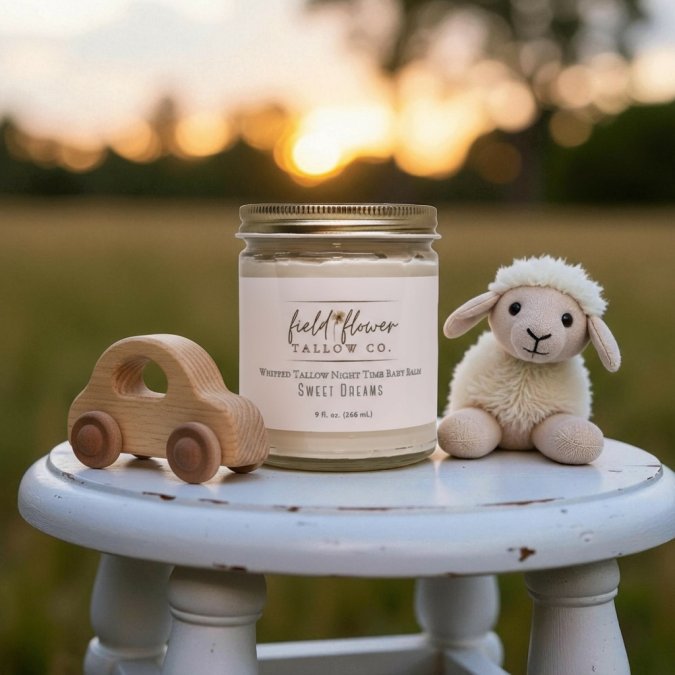
Sweet Dreams Tallow Baby Balm →
What "grass-fed" and "grass-finished" actually mean
- Grass-fed generally means the cattle had access to pasture and forage for most of their lives. The term is used loosely, and labeling standards vary.
- Grass-finished is the stricter claim: the animal was fed forage, not grain, all the way through to slaughter. Grain finishing changes the fatty acid profile of the fat that ends up in your balm.
- Pasture-raised describes living conditions, not diet. A pasture-raised cow can still be grain-finished.
For skincare, grass-finished is the more meaningful claim because it speaks to the composition of the fat itself. If a brand says "grass-fed" but cannot say whether the animal was grain-finished, the sourcing is not tightly controlled.
What "rendered" means, and why the method matters
Rendering is the process of melting fat away from tissue and straining out the solids. There are two broad approaches:
- Wet rendering uses water or steam to separate the fat. It is faster and higher-yield, but can leave more residual moisture and a stronger odor.
- Dry rendering heats the fat without added water. It is slower and lower-yield, but produces a cleaner, more shelf-stable fat with a milder scent.
What "tallow" can hide
"Tallow" on a label does not tell you which fat was used. Beef fat from different parts of the animal behaves differently:
- Kidney fat (suet) is the firmest, cleanest-tasting, and most prized for skincare. It is high in saturated fat and produces a stable, mild balm.
- Subcutaneous fat from the back and flanks is softer and slightly less stable.
- Mixed trim is whatever is left over, the cheapest input and the most likely to carry an off scent.
Reading the ingredient list like an editor
A short list is good, but a short list of the right things is better. For a baby balm, look for:
- Tallow as the first ingredient, it should be the base, not a token addition
- Simple plant oils such as olive, jojoba, or coconut, which condition the skin and improve spreadability
- Vitamin E (tocopherol) as an antioxidant to help protect the oils from going rancid
- No synthetic fragrance, "fragrance" or "parfum" on a baby product is a reason to keep looking
- Essential oils used sparingly, if at all, lavender and chamomile are generally gentle, but peppermint, eucalyptus, citrus, and cinnamon are not appropriate for infant skin
- No water, no emulsifiers, no synthetic preservatives, if water is on the list, it is a lotion, not an anhydrous balm, and it needs a preservation system to match
Questions worth asking a brand directly
A transparent brand will answer these without hedging:
- Where is the tallow sourced, and is it grass-finished?
- Which fat is used, suet, subcutaneous, or mixed trim?
- Is the fat wet-rendered or dry-rendered?
- Is the balm scented, and with what?
- Is a full ingredient list published for each product?
If the answers are vague, the product is probably not the one you want for a newborn.
Scent, texture, and the "small amount" rule
A high-quality tallow balm should be firm in the jar, melt quickly between warm palms, and absorb without a heavy residue. It should smell faintly of its ingredients, clean fat, a hint of olive or coconut, maybe a soft botanical note, and nothing else. Because it is concentrated and water-free, a pea-sized amount is enough for a baby's whole body.
Frequently Asked Questions
Is beef tallow safe for newborn skin?
Newborn skin is thinner and more permeable than adult skin, so introduce any new product slowly. A water-free tallow balm made with simple ingredients like grass-fed beef tallow, olive oil, and coconut oil is generally well tolerated, but a patch test on the inner arm is essential. Apply a small amount, wait 24 hours, and watch for redness, bumps, or irritation. If your baby has a diagnosed skin condition or is under a pediatrician's care, ask before using tallow balm.
Can tallow balm help with baby eczema flare-ups?
Tallow balm for baby eczema is popular because its rich lipids help soften dry, rough patches and support the skin barrier, which can reduce moisture loss. It is not a treatment for eczema, and it will not replace a pediatrician's plan. Many parents apply it to damp skin after a bath to help seal in moisture. If flare-ups are frequent, painful, or oozing, talk to your pediatrician before adding any new product to your routine.
How do I patch test tallow balm on my baby?
Apply a pea-sized amount to a small area on your baby's inner arm or behind the knee. Wait 24 hours and check for redness, swelling, or bumps. If the skin stays calm, test a slightly larger area for another day before using it on the face or diaper area. Stop immediately if you see any reaction. Patch testing is the single most important step before using tallow balm on sensitive skin.
What ingredients should I avoid in baby skincare?
Watch for synthetic fragrance, essential oils that are not diluted properly, and preservatives that irritate reactive skin. Some babies react to lavender or chamomile, so an unscented balm is often the safest starting point. Choose products with short, recognizable ingredient lists and no added water, since water-based formulas require preservatives. If your baby has known allergies, review the full ingredient list with your pediatrician first.