

10 Ancestral Skincare Ingredients for Beginners
Last Updated: November 1, 2026
Quick Summary
Ancestral skincare is a fat-first approach built on concentrated lipids, plant oils, and botanicals instead of water-based emulsions. Beginners should start with grass-fed beef tallow, jojoba oil, olive oil, coconut oil, and beeswax, then add botanicals like calendula and rosehip seed oil once the basics feel familiar.
- Ancestral formulas skip the water phase entirely, so they condition and protect rather than deliver water.
- Apply tallow balm to slightly damp skin so the balm can help reduce moisture loss.
- Patch test a new product on your inner forearm or jawline for 24 to 48 hours.
- Introduce one new product at a time and give it at least a week.
- A basic routine needs only a gentle cleanse, a conditioning step, and consistency.
Table of Contents
- Why Ancestral Skincare Is Different From a Drugstore Routine
- 1. Grass-Fed Beef Tallow
- 2. Jojoba Oil
- 3. Olive Oil
- 4. Coconut Oil
- 5. Beeswax
- 6. Calendula
- 7. Rosehip Seed Oil
- How to Use Tallow Balm Without Overdoing It
- How to Patch Test Skincare Products
- Building a Basic Skincare Routine for Beginners
- Quick Reference: The 10 Ingredients at a Glance
- Where Beginners Usually Go Wrong
- Frequently Asked Questions
Why Ancestral Skincare Is Different From a Drugstore Routine
Ancestral skincare is a fat-first approach to skin care built on concentrated lipids, plant oils, and botanicals rather than water-based emulsions. Most drugstore lotions rely on a large water phase held together with emulsifiers and preserved against microbial growth. Ancestral formulas skip that architecture entirely.
That distinction matters more than any single ingredient. A water-based lotion delivers hydration and then needs help holding onto it. A lipid-based balm coats and conditions the skin, creating a protective layer that helps reduce moisture loss. Both have a place, but they are not the same product wearing different labels. For a closer look at what tallow can and cannot do for wrinkles, read Does Beef Tallow Really Get Rid Of Wrinkles.
We build around grass-fed beef tallow and recognizable plant oils. Our balms are anhydrous, meaning they contain no water phase at all. That is a different formulation approach, not a stripped-down lotion.
The ten ingredients below are ones a beginner may want to learn about first. None require a chemistry degree to understand.
1. Grass-Fed Beef Tallow
Tallow is rendered beef fat, composed mainly of triglycerides and fatty acids.
What Tallow Does for Dry, Reactive Skin
Tallow provides rich lipids that soften and condition dry, rough skin. Its texture creates a protective layer on the surface that helps slow moisture loss.
It is not a source of water. Tallow does not add hydration in the way a water-based product does. What it does is condition the skin and help seal in the moisture already there. For very dry skin, apply it to slightly damp skin so the balm can help reduce evaporation of that surface water.
A common mistake is scooping too much. These balms are concentrated, so a small amount goes a long way.
If you want the simplest possible starting point, our Unscented Tallow Face + Body Balm uses just four ingredients with no added fragrance or essential oils, which makes it a reasonable first tallow product for sensitive or reactive skin. If you would rather start with cleansing, the Simply Radiant Tallow Cleansing Serum is an unscented oil cleanser built on the same tallow base.


2. Jojoba Oil
Jojoba is a liquid wax ester, not a true oil, and that structure is why it feels lighter than most plant oils. It conditions the skin and gives a balm a smoother, more elegant finish.
Beginners often assume anything called an oil will feel greasy. Jojoba is the counterexample. Its light structure makes it a good bridge ingredient for anyone nervous about fat-based skincare.
3. Olive Oil
Olive oil is rich in oleic acid and other lipid components. In a balm, it softens and conditions the skin while improving spreadability, so the product glides instead of dragging.
Our balms use organic extra virgin olive oil, and it is one of the most recognizable ingredients in the entire category, which matters if you are trying to build a routine you can actually read.
Unscented Tallow Face + Body Balm →
Where it falls short: olive oil alone is thin and finishes slowly. It works best as part of a balanced formula rather than as a standalone moisturizer.
4. Coconut Oil
Coconut oil contributes emollience and helps soften and condition the skin. It is one of the most familiar ingredients in natural skincare, and for beginners that familiarity is an advantage.
In a concentrated balm, coconut oil helps the formula melt on contact and spread evenly. It also supports the protective feel of the finished product.
Watch out: some people find coconut oil irritating. If you are acne-prone, patch test any coconut-containing balm on your jawline for a few days before using it across your whole face.
5. Beeswax
Beeswax adds structure and firmness to a balm and contributes to its protective qualities. A whipped balm without wax is soft and airy. A poured balm with wax is firmer and melts more slowly into the skin.
That slower melt is the point. Wax helps the balm stay where you put it and release nourishment over a longer stretch instead of absorbing all at once.
Beginners sometimes read "beeswax" and assume a waxy, occlusive feel. In a well-built formula it is barely noticeable, just a firmer texture in the jar. You can browse the Seasonal Tallow Body Balms to see how waxes and botanicals shape each formula.
6. Calendula
Calendula is a traditional botanical used for soothing and calming the skin (An Updated Review on the Multifaceted Therapeutic Potential of Calendula officinalis L). It is most often infused into a carrier oil, like jojoba, rather than added as a raw petal.
Calendula has a long history in skin preparations. Traditional use is not the same as clinical proof, so if you have known plant allergies, patch test first.
7. Rosehip Seed Oil
Rosehip seed oil is naturally rich in vitamin A and essential fatty acids.
It is also one of the ingredients most likely to oxidize, which is why you see it in smaller, darker packaging and why shelf life matters. A rosehip formula that has gone rancid will smell off and do nothing useful. If you are ready to build a routine, the Soap Balm Routine collection offers a simple soap-and-balm starting point.
How to Use Tallow Balm Without Overdoing It
Start with a small amount and warm it between your fingertips until it melts. Press it into clean skin rather than rubbing hard.
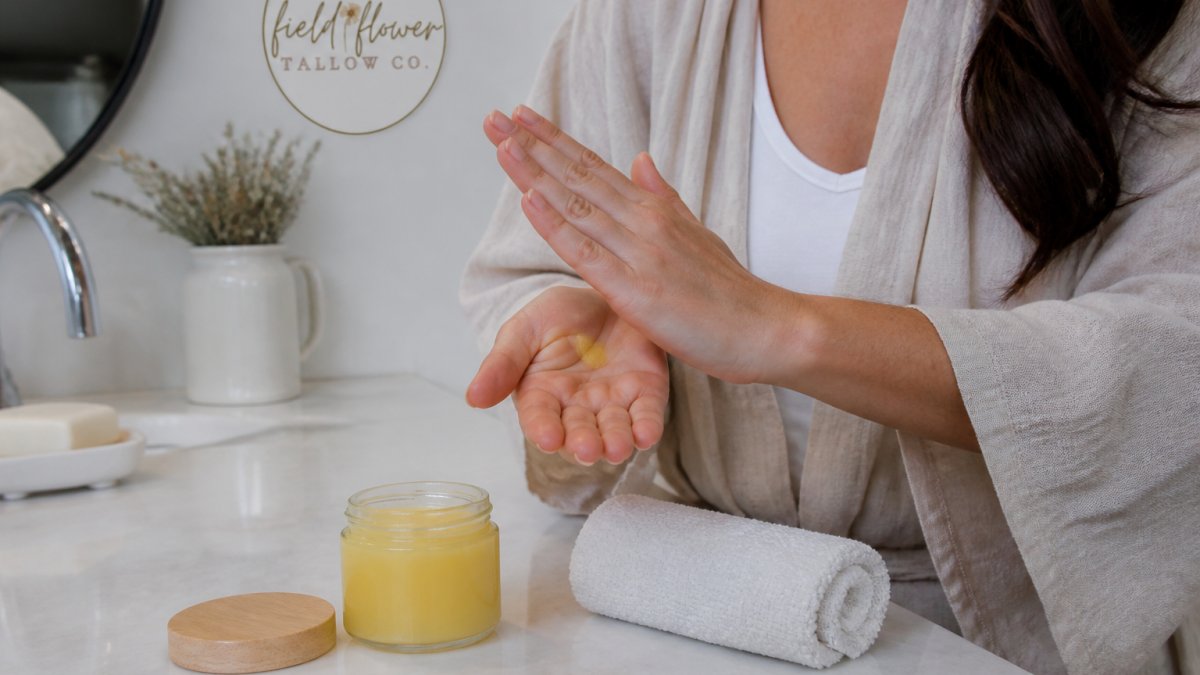
The most common beginner error is treating a concentrated balm like a lotion and applying far too much. That leads to a heavy, slick finish and wasted product. Less is genuinely more here.
For daytime use, apply a small amount and allow time for absorption before makeup. For very dry skin, apply to slightly damp skin after cleansing so the balm can help reduce moisture loss from the surface.
How to Patch Test Skincare Products
Patch testing is the single most useful habit a beginner can build, and it takes about a week. Apply a small amount of the product to a small area of skin, usually the inner forearm or jawline, and leave it alone for 24 to 48 hours. If there is no reaction, repeat once more before using it more widely.
Unscented Tallow Face + Body Balm →
Stop and discontinue if you notice redness, itching, stinging, or swelling. This is especially important with essential-oil-containing formulas, since plant oils can irritate sensitive skin even when they are natural.
A patch test is not a guarantee. It reduces risk; it does not eliminate it. If you have a diagnosed skin condition, talk to your dermatologist before adding any new product.
Building a Basic Skincare Routine for Beginners
A basic skincare routine for beginners needs three things: a gentle cleanse, a conditioning step, and consistency. That is it. Most people do not need ten products.
- Cleanse: Use a gentle cleanser that does not strip the skin. Oil cleansing lifts makeup, sunscreen, and excess oil without leaving skin tight.
- Condition: Apply a lipid-rich balm or serum to soften, condition, and help reduce moisture loss.
- Protect: If you are using anything with active botanicals in the morning, follow with sun protection.
The order matters less than the consistency. A simple routine done daily beats an elaborate one done twice a week.
Watch out: adding five new products at once makes it impossible to tell what is working and what is irritating your skin. Introduce one product at a time and give it at least a week.
Quick Reference: The 10 Ingredients at a Glance
| # | Ingredient | Primary Role | Best For | Beginner Note |
|---|---|---|---|---|
| 1 | Grass-fed beef tallow | Rich lipids, barrier support | Dry, reactive skin | Use a pea-sized amount |
| 2 | Jojoba oil | Light conditioning | All skin types | Carries botanical infusions |
| 3 | Olive oil | Softening, spreadability | Normal to dry skin | Look for extra virgin |
| 4 | Coconut oil | Emollience, softening | Dry skin | Patch test if acne-prone |
| 5 | Beeswax | Structure, protection | Poured balms | Firmer texture, slower melt |
| 6 | Calendula | Soothing, calming | Sensitive skin | Usually infused into oil |
| 7 | Rosehip seed oil | Regeneration support | Mature, uneven skin | Check for freshness |
| 8 | Vitamin E | Antioxidant, oil protection | All formulas | Protects the oils themselves |
| 9 | Carrot seed oil | Skin renewal support | Dull, tired skin | Often paired with tallow |
| 10 | Essential oils | Scent and skin feel | Scented formulas | Skip if skin is reactive |
Where Beginners Usually Go Wrong
Three mistakes account for most of the frustration people bring to us.
The first is expecting a fat-based balm to behave like a water-based lotion. It will not. It is richer, more concentrated, and it works by conditioning and protecting rather than by delivering water.
The second is skipping the patch test because the ingredients sound natural. Natural does not mean hypoallergenic. Essential oils, in particular, cause reactions in some people.
The third is quitting after three days. Skin conditioning is gradual. Give a new product a few weeks of consistent use before deciding whether it works for you.
One more thing worth saying plainly: traditional use is not proof. Ancestral ingredients have long histories, and that history is meaningful, but it is not the same as clinical evidence. Read claims carefully, including ours.
Building a routine from ingredients you can actually pronounce should not require a shelf full of products or a chemistry reference. We make anhydrous, tallow-based skincare in small batches, with formulas built on grass-fed beef tallow, olive oil, jojoba, coconut oil, and recognizable botanicals. Our balms are concentrated, so a little goes a long way, and our unscented options are made without added fragrance or essential oils for people whose skin reacts easily. Start with one product, patch test it, and see how your skin responds. Get started and build a short, simple routine you can keep up with.
Frequently Asked Questions
Which ancestral skincare ingredient is best for dry, reactive skin?
Grass-fed beef tallow is a fat-based ingredient that helps soften rough patches and reduce moisture loss by forming a protective lipid layer. It is not a water-based moisturizer, so it conditions rather than adding water. Pair it with jojoba oil for a lighter feel, and always patch test on your inner forearm for 24 to 48 hours before applying it to your face.
How do beginners add a new skincare ingredient to their routine?
Add one new ingredient at a time and use it for at least a week before introducing another. Start with a small amount, apply it to a limited area, and note how your skin feels over the following days. This makes it easier to identify which ingredient caused a reaction if one appears. A basic skincare routine for beginners usually needs only a gentle cleanser, one conditioning balm or oil, and sun protection.
Can you use a tallow balm on your face?
Yes. Tallow balm can be used on the face and body. Apply it to clean, slightly damp skin so it can help reduce moisture loss.
How should you patch test a new skincare ingredient?
Apply a small amount to the inside of your forearm or behind your ear, leave it uncovered, and wait 24 to 48 hours. Watch for redness, itching, or swelling. If your skin stays calm, repeat the test on a small area of your face before using the product all over. Stop using it and speak with a dermatologist if you notice a reaction, especially if you have eczema or a known sensitivity to essential oils.
