

Does Beef Tallow Really Get Rid of Wrinkles?
Last Updated: October 22, 2026
Quick Summary
Does beef tallow really get rid of wrinkles? Yes. Tallow conditions skin and can temporarily soften the look of fine lines by reducing moisture loss.
- Fine lines may look softer within days to a couple of weeks of consistent use, from surface conditioning.
- A tallow balm can help offset retinol dryness.
- Apply a dime-sized amount warmed between your palms to slightly damp skin as the final step at night.
Table of Contents
- Does Beef Tallow Really Get Rid of Wrinkles?
- Beef Tallow for Face: Benefits and Side Effects
- How Long Does Beef Tallow Take to Work on Wrinkles?
- Beef Tallow vs Retinol for Wrinkles
- How to Use Tallow on Facial Skin
- Sourcing and Product Quality: What to Look For
- Frequently Asked Questions
Does Beef Tallow Really Get Rid of Wrinkles?
Yes. Below, we explain what tallow actually does for facial skin, where the claims outrun the evidence, and how to use it without clogging your pores.
Wrinkles form in the dermis, where collagen and elastin decline over time. A topical fat sits on the surface. It can help reduce moisture loss and leave skin looking plumper.
Beef Tallow for Face: Benefits and Side Effects
Beef tallow for face benefits and side effects both come down to one fact: tallow is a rendered animal fat made mostly of triglycerides and fatty acids, and our balms are water-free. That means tallow conditions skin with concentrated lipids rather than delivering a water-based moisturizer. The upside is rich, lasting softening and barrier support. The tradeoff is that a heavy fat can feel occlusive on oily or acne-prone skin.
What Tallow Can Do for Dry, Irritated Skin
Dry, rough, irritated skin responds well to lipid-rich conditioning. For especially dry skin, apply balm to slightly damp skin so it can help slow the evaporation of water already on the surface. Our Unscented Tallow Face + Body Balm leans on grass-fed beef tallow, coconut oil, olive oil, and vitamin E for exactly this job, with no added fragrance for reactive skin.

What Tallow Cannot Do for Wrinkles
What it can do is soften the appearance of fine lines temporarily by conditioning dry, rough surface skin and helping it hold moisture. That is a real benefit, but it is cosmetic and short-lived.
How Long Does Beef Tallow Take to Work on Wrinkles?
How long does beef tallow take to work on wrinkles? Expect the appearance of fine lines to soften within days to a couple of weeks of consistent use, because that change comes from surface conditioning, not structural repair. Deeper wrinkles will not change on any timeline, because a topical fat does not reach the dermis to rebuild collagen. If a product promises visible wrinkle reduction in a set number of weeks, treat that as marketing.
Beef Tallow vs Retinol for Wrinkles
Beef tallow vs retinol for wrinkles is not a close contest on the wrinkle question, but the reason matters more than the verdict. Retinol is a vitamin A derivative with decades of human clinical research behind it; tallow is a lipid-rich conditioner with a plausible mechanism and no comparable trial evidence for wrinkle reversal. Understanding why that gap exists, and what it would take to close it, is more useful than a one-line scorecard.
What the evidence actually looks like
Retinol's case rests on controlled human studies, not ingredient theory. Researchers have measured changes in fine lines, texture, and tone over months of consistent use, and dermatology organizations treat topical retinoids as a first-line option for photoaging.
Tallow's case is different in kind. The reasoning is mechanistic: tallow is a rendered fat rich in fatty acids, it conditions the skin, and it forms a protective lipid layer that helps reduce moisture loss.
What a fair comparison would require
To say tallow reduces wrinkles the way retinol does, you would need the same kind of evidence retinol has: a controlled study, a measured outcome (wrinkle depth, elastin content, or a validated clinical grading scale), a duration long enough to see structural change, and a comparison group. Until that exists, the honest framing is that tallow improves the appearance of dry, lined surface skin while retinol has been shown to influence the skin's structure over time.
Can you use both?
Yes, and many people do, but the logic is comfort, not synergy. Retinol often causes dryness, flaking, and irritation while skin adjusts, and a rich, water-free balm can help offset that by conditioning the skin and reducing moisture loss.
A common pattern is retinol at night on dry skin, then a small amount of tallow balm on top or on off nights.
Option |
What it targets |
Evidence base |
Typical timeline |
Main tradeoff |
|---|---|---|---|---|
Beef tallow balm |
Softening, barrier support, reduced moisture loss |
Mechanistic and anecdotal; no wrinkle trials |
Days to weeks for surface feel |
No evidence for wrinkle removal |
Retinol |
Texture, tone, collagen support |
Controlled human studies |
Months of consistent use |
Irritation, sun sensitivity |
Sunscreen |
Preventing further damage |
Strong, well-established |
Daily, ongoing |
Requires daily habit |
Skin-type guidance
- Dry or mature skin: Usually the best fit. Rich conditioning and reduced moisture loss are exactly what this skin type needs, and congestion is less likely.
- Normal or combination skin: Often fine in a thin layer at night, especially on drier zones like cheeks. Watch the T-zone.
- Oily skin: Use sparingly or skip the full face. If you try it, keep it to dry patches and the perimeter of the face rather than the center.
When to stop
Stop using a tallow balm if you notice new clogged pores, persistent redness, stinging, or breakouts that appear after you started. Give it a week or two of consistent use before judging, a single night tells you little, but do not push through irritation hoping it settles. Skin that is reacting is telling you the product is not the right match, and no amount of 'good ingredients' changes that.
If you are prone to breakouts, start with two or three nights a week and watch for inflammation or new clogged pores. Our Unscented Tallow Face + Body Balm is the gentlest place to begin because it carries no added fragrance or essential oils that could add irritation on top of the richness. If your skin is oily or acne-prone and you want conditioning without a heavy layer, use a very small amount on dry areas only, and keep the center of your face clear.
How to Use Tallow on Facial Skin
Using tallow on facial skin takes about a minute: cleanse, apply to slightly damp skin, and use a small amount warmed between your hands. A little goes a long way with a concentrated, water-free balm.
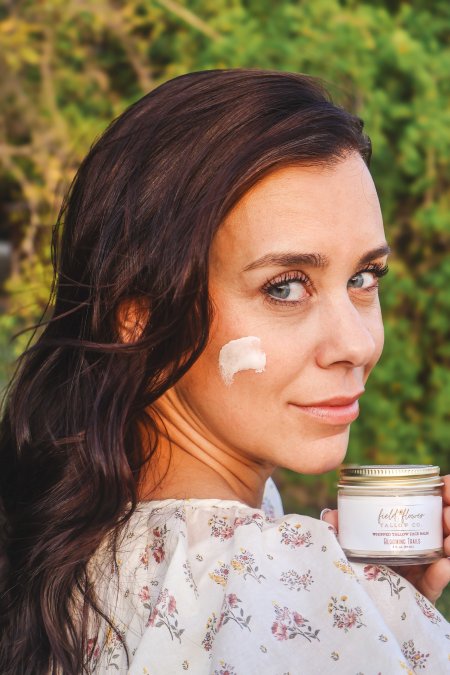
- Cleanse with a gentle cleanser and pat skin so it is still slightly damp.
- Scoop a dime-sized amount and warm it between clean palms until it melts.
- Press and massage into the face, focusing on dry patches and fine lines.
- Use morning, evening, or both, and apply as the final step of your routine.
- Patch test on the jawline first if your skin is acne-prone or reactive.
For a more structured balm with botanical support, our Morning Magnolia Face Balm is poured with organic beeswax and includes rosehip seed oil and sea buckthorn extract, and the listing notes it is shown to reduce the look of fine lines on dry or mature skin.

Sourcing and Product Quality: What to Look For
Sourcing and processing decide whether a tallow balm is worth using. Look for grass-fed or grass-finished beef tallow as the first ingredient, a short ingredient list you can actually read, and no added fragrance if your skin is sensitive.
- Tallow listed first, described as grass-fed or grass-finished
- Few, recognizable ingredients with no mystery fillers
- No added fragrance or essential oils if skin is reactive
- Small-batch maker willing to share sourcing details
The U.S. Food and Drug Administration's cosmetics guidance is a reasonable starting point for understanding how cosmetic ingredients are regulated. For anyone weighing tallow against established treatments, the American Academy of Dermatology's guidance on wrinkles is a useful reality check on what actually reduces lines. And if you are comparing ingredient lists across brands, the Environmental Working Group's Skin Deep database offers a searchable reference for common cosmetic ingredients.
The hard part is not finding a tallow balm. It is finding one that conditions your skin without the meaty smell that turns people off, and that is honest about what a fat-based formula can and cannot do.
Frequently Asked Questions
How long does it take for beef tallow to work on wrinkles?
Most people notice softer, plumper-looking skin within a week or two of daily use, because a lipid-rich balm reduces moisture loss and temporarily smooths the look of fine lines. Deeper wrinkles will not change from tallow alone. Tallow conditions the surface and supports the skin barrier, but it does not rebuild collagen or elastin in the dermis, which is what actually drives permanent wrinkle reduction. Judge it on skin comfort and texture, not on erasing lines.
Can beef tallow clog pores or cause breakouts?
It can, for some skin types. Tallow is a rich, fatty ingredient, and people with oily or acne-prone skin may find heavy balms contribute to clogged pores. If you are prone to breakouts, patch test on your jawline for a week before applying tallow across your whole face. Those with dry or compromised skin usually tolerate it well. Watch for new bumps or congestion and stop if they appear.
Is beef tallow a good alternative to retinol for wrinkles?
They do different jobs. Retinol has clinical evidence behind it for stimulating collagen and softening wrinkles over months of use, though it often causes irritation and peeling at first. Tallow has no comparable evidence for wrinkle reversal. It moisturizes, conditions, and helps reduce moisture loss, which can make skin look plumper and calmer. Many people use both: a tallow balm to cushion and condition, and retinol on alternate nights for the long-term collagen work.
Is beef tallow safe to use on your face every day?
For most people with dry or normal skin, yes. A small amount morning or evening is enough, since concentrated balms spread further than lotions. If you have sensitive skin, start with an unscented formula and patch test first. Avoid applying to damp skin if the product contains active botanicals, and stop if you notice irritation, redness, or congestion. Anyone with a diagnosed skin condition should check with their dermatologist before adding a new product.