

How to Spot Hidden Toxic Ingredients in Everyday Products
Table of Contents
- Why Hidden Toxic Ingredients Slip Past Labels
- How to Read Skincare Ingredient Labels Step by Step
- Skincare Ingredients to Avoid and Why They Raise Concerns
- What 'Fragrance' Really Means in Skincare Ingredient Lists
- How to Check Cosmetic Ingredients Before You Buy
- Hidden Ingredients in Food and Everyday Products
- How to Prioritize Which Exposures to Reduce First
- Frequently Asked Questions
Last Updated: October 7, 2026
Why Hidden Toxic Ingredients Slip Past Labels
Learning how to spot hidden toxic ingredients starts with one uncomfortable fact: a label can be completely legal and still tell you almost nothing. In the United States, the FDA does not review or approve cosmetic ingredients before they go on the market, and it has no power to order a recall of a cosmetic that harms someone, according to FDA authority over cosmetics.
At Field Flower Tallow Co., we read ingredient panels every day, and the pattern is always the same. The front of the package makes a promise. The back of the package is where the truth lives.
- Flavor and fragrance are trade secrets. A single word can hide dozens of chemicals.
- "Natural" and "clean" mean almost nothing. No agency defines them.
- Small amounts add up. You use many products, every single day.
The Difference Between Hazard, Exposure, and Risk
Hazard, exposure, and risk are three different things, and mixing them up is the fastest way to panic over nothing. A hazard is whether a substance can cause harm; exposure is how much actually reaches your body; risk combines the two. A chemical that causes cancer in high-dose animal studies is not automatically dangerous at trace levels in your shampoo, but one you use on your whole body daily for years deserves more scrutiny than one you touch once.
How to Read Skincare Ingredient Labels Step by Step
Ingredient lists run from highest concentration to lowest. Anything near the top is most of the product; anything after "fragrance" is often trace.
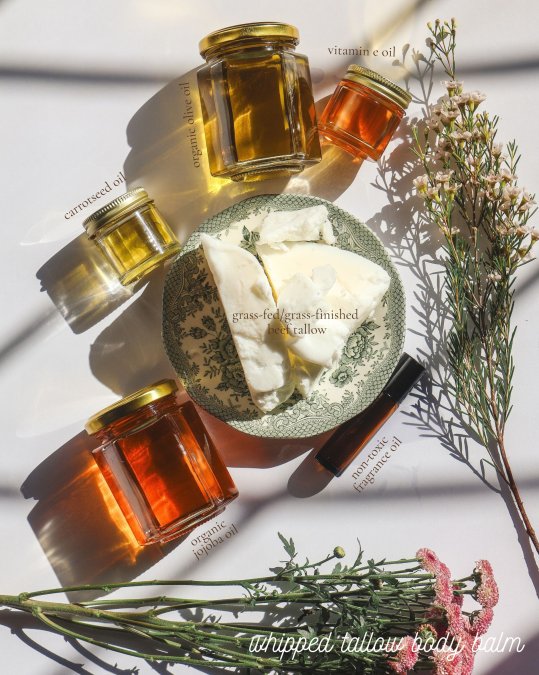
The ingredients used by Field Flower Tallow Co in their Whipped Tallow Body Balms
Here is our step-by-step method:
- Find the word "fragrance" or "parfum." This single term can hide an entire blend of undisclosed chemicals. Circle it every time.
- Scan the first five ingredients. These make up most of the formula. If water is first, you are holding a water-based product. If a fat or oil is first, you are holding an anhydrous, lipid-based product.
- Check for preservatives. Water-containing products need them to control microbial growth. That is normal and not a red flag on its own. A water-free balm has a different formulation and preservation challenge.
- Look up the last three ingredients. These are usually the ones a brand hopes you skip. Low concentration does not mean zero, especially in a product you use daily.
- Compare the front claim to the back list. If the front says "unscented," the back should not list fragrance.
- Note the order of the top three. In a water-based lotion, water is usually first and oils come later. In a tallow balm, tallow and plant oils lead the list because they are the formula, not an additive.
Ingredient-Name Aliases and Label Loopholes
The same chemical can appear under many names. Cosmetic ingredients are usually listed by INCI name (International Nomenclature of Cosmetic Ingredients), which is why you see Latin plant names and chemical names instead of plain English. Common aliases:
- Fragrance also hides as "parfum," "aroma," or "essential oil blend."
- Phthalates often hide inside "fragrance" and are rarely listed by name. Diethyl phthalate (DEP) is one that sometimes appears on its own.
- BHA and BHT are preservatives in food and cosmetics; BHA is also written as butylated hydroxyanisole.
One loophole matters most. Under current rules, "fragrance" does not have to be broken down on the label, even though a single fragrance can contain many compounds. That is a legal trade-secret exemption, not a conspiracy.
A second loophole is the difference between a claim and an ingredient. "Fragrance-free" and "unscented" are marketing terms, not regulated definitions. A product labeled unscented can still contain masking fragrance.
How to Verify a Claim Before You Trust It
A label claim is a starting point, not proof. Verify it in this order:
- Check the ingredient list first. It is the most concrete thing on the package.
- Search the ingredient name in a public database. The Environmental Working Group's Skin Deep database lets you look up products and individual ingredients. It is not perfect, and its scoring system is debated, but it is a fast starting point.
- Look for third-party testing seals, not just brand claims. A seal from an independent lab carries more weight than a logo a brand designed itself.
This is the same lens we use on our own formulas. A short, recognizable list is easier to verify than a long one you cannot decode.
Skincare Ingredients to Avoid and Why They Raise Concerns
No single ingredient list applies to everyone, but a few categories come up again and again. Here is what we watch for.
- Phthalates: used to make fragrances last longer and plastics more flexible. Linked to endocrine disruption in some research, and often hidden inside "fragrance" rather than listed by name.
- Parabens: preservatives that some studies tie to hormone effects. They are effective at what they do, and the concern is about cumulative exposure rather than any single product.
- Synthetic musks: common in perfume, slow to break down, and able to accumulate in the body over time.
Hazard, Exposure, and Risk Are Not the Same Thing
A hazard is whether a substance can cause harm under some conditions. Exposure is how much actually reaches your body, by which route, and how often. Risk combines the two.
A chemical that causes tumors in high-dose animal studies is not automatically dangerous at trace levels in a rinse-off cleanser, but one you apply to your whole body daily for years deserves more scrutiny than one you touch once.
How to Weigh Evidence Quality
Not all studies are equal, and a headline is not a finding. When you read that an ingredient is "linked to" something, ask:
- Was it a human study or an animal study? Animal and cell studies point toward questions. Human studies answer them.
- What was the dose? A study using concentrations far above real-world use tells you less than one using realistic exposure.
- Who funded it? Industry-funded and independent research can both be valid, but knowing the source helps you weigh it.
Most of the research behind these concerns is about high exposure, not your daily balm. That does not make the concerns fake. It means the right response is proportionate, not panicked.
What This Means for a Lipid-Based Routine
If you use a product on your whole body every day, reducing known chemicals of concern is a reasonable choice. That is one reason we build our balms around a short list: grass-fed beef tallow, recognizable plant oils like olive, jojoba, and coconut, and vitamin E to help protect the oils from oxidation.
A tallow balm is a concentrated, lipid-based skin conditioner. It delivers rich lipids that soften and condition the skin and help reduce moisture loss by forming a protective layer, a different job than a water-based lotion does.
What 'Fragrance' Really Means in Skincare Ingredient Lists
"Fragrance" is a catch-all term that can legally stand in for a blend of dozens of undisclosed compounds.
If you have reactive skin, the safest path is a product with no added fragrance or essential oils at all. At Field Flower Tallow Co, we are required by law to list our fragrances as “Fragrance Oil” even though our fragrances aren’t synthetic. We use blends of essential oils, botanicals and occasionally extracts, which are all found in nature.
The ingredients used by Field Flower Tallow Co in their Whipped Tallow Body Balms
How to Check Cosmetic Ingredients Before You Buy
Checking cosmetic ingredients before you buy takes about two minutes, and it works best as a routine. You do not need a chemistry degree.
Try this pre-purchase checklist:
- Photograph the ingredient panel in the store
- Search each unfamiliar name in a public product database
- Check whether "fragrance" appears anywhere on the list
The Environmental Working Group's Skin Deep database lets you look up products and individual ingredients by name.
One more thing. A brand that lists every ingredient plainly is telling you something. Transparency is a choice, and not every company makes it.
Hidden Ingredients in Food and Everyday Products
Food labels hide ingredients in ways cosmetics do not. The biggest category is added sugar, which appears under more than 60 different names, including syrups, nectars, and juice concentrates. The FDA now requires "added sugars" on the Nutrition Facts panel, which helps, but the ingredient list still hides the rest. Other common hidden ingredients:
- Artificial colors: Red 40, Yellow 5, Yellow 6, and Blue 1 are synthetic dyes tied to sensitivity in some children.
- Artificial sweeteners: aspartame, sucralose, and saccharin appear under many brand names.
- Preservatives: BHA, BHT, and sodium benzoate are common in packaged foods.
For food, the fix is simpler than for skincare. Buy fewer packaged items, and the list of ingredients you need to decode shrinks on its own.
How to Prioritize Which Exposures to Reduce First
You cannot eliminate every chemical exposure, and trying will make you miserable.
Priority |
Product Type |
Why It Ranks High |
First Swap |
|---|---|---|---|
1 |
Body lotion and balm |
Used daily, full body |
Clean Fragrance Tallow Balm |
2 |
Cleanser and soap |
Daily, whole body |
Simple fat-based bar |
3 |
Sunscreen |
Large area, often daily |
Mineral zinc formula |
4 |
Lip products |
Ingested in small amounts |
Clean Flavored, short list |
5 |
Perfume |
High fragrance load |
Reduce or skip |
6 |
Household cleaners |
Inhaled, skin contact |
Fewer, simpler products |
Children, pregnancy, and sensitive groups deserve extra care, so start your swaps with the products they use every day. This is where a simple, fat-based routine helps: our Unscented Tallow + Goat's Milk Soap and Bare Bliss Tallow Lip Balm are built on short ingredient lists you can actually read, and our Pure Shield Tallow Sun Barrier Balm uses non-nano zinc oxide rather than chemical filters.


Learning how to spot hidden toxic ingredients is a habit, not a one-time task. Read the back of the package, question the front, and start with the products you use most.
At Field Flower Tallow Co., we keep our formulas short on purpose: grass-fed beef tallow, recognizable plant oils, and no added fragrance.
Frequently Asked Questions
How can you find out if skincare ingredients are toxic?
Start with the ingredient panel, not the front of the package. Read the full list, then check names you do not recognize against a public product database or the manufacturer's own site. Look for broad terms like 'fragrance' or 'parfum' that can stand in for dozens of undisclosed compounds. Remember that hazard and risk are not the same thing: a substance flagged as a chemical of concern matters most when it appears high in the list, in a leave-on product, or in something you use daily.
What does it mean when a product label uses a broad ingredient term?
Broad terms such as 'fragrance,' 'parfum,' or 'natural flavoring' let a manufacturer list a category instead of each individual component. Under current US labeling rules, fragrance mixtures do not have to be broken down on the package. That does not automatically make the product unsafe, but it does mean you cannot verify what is inside from the label alone. If you want full ingredient transparency, choose products that name every component, including any essential oils used for scent.
Are natural skincare ingredients always safe?
No. 'Natural' describes where an ingredient comes from, not how it behaves on skin. Essential oils, botanical extracts, and some plant compounds can trigger irritation or allergic reactions, especially on sensitive or reactive skin. A fragrance-free, short ingredient list is often the simplest starting point. When a formula contains only recognizable fats, oils, and waxes, like a tallow-based balm, you can read every name and know what you are applying.
How can you check whether a skincare product contains ingredients you want to avoid?
Work from the back label. Scan the first five ingredients, since they make up most of the formula, and flag anything you have decided to avoid. Check the scent line: if it says 'fragrance' or 'parfum,' the specific components are not disclosed. Then verify the brand's claims against its own published ingredient list rather than marketing copy. If a company will not publish a full list, treat that as a signal about how much ingredient transparency you can expect.